Section 4.2 · Further exercises · 3 of 10
Exercise 4.2.3: Refraction of B at an interface
About the further exercises of Section 4.2
Ten further exercises in the spirit of Problems 4.2.1–4.2.5, the worked examples and the home exercises, graded from easy to harder. Exercises 4.2.1–4.2.3 are about magnetic media and the boundary conditions, Exercises 4.2.4–4.2.5 about Ohm's law and the Joule phenomenon, Exercises 4.2.6–4.2.8 about inductance and energy, and Exercises 4.2.9–4.2.10 about dipoles and coupled circuits. They use only
As in the lectures, carries the units of (tesla), so is the magnetisation in A/m.
Refraction of B at an interface
#cf. boundary conditions
The plane separates two magnetic media: for and for . There is no surface current on the interface. In medium 1, just below the interface, . Find (a) and , (b) the angles , that , make with the normal, and check , (c) the magnetisation on both sides.
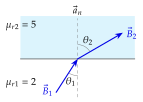
is continuous, is continuous (no surface current), so the tangential part of is multiplied by . Everything else is bookkeeping.
The normal component of is continuous: . With the tangential component of is continuous, :
(. For comparison : the tangential part is indeed the same, the normal part jumps by .)
:
in agreement with Eq. (4.2.13).
:
Read , , and off the table of components and compare them with steps (a) to (c).
The line of bends away from the normal on entering the medium of higher , from to . For iron against air () the bending is so strong that flux leaves the iron almost normally whatever its direction inside, the fact that makes a magnetic circuit behave like a wire circuit. Note that the tangential part of jumps at the interface, from to mT in its and components. This jump is the bound surface current A/m that the interface carries, although the free surface current is zero. (The jump of , from to mT, adds nothing to it, because .)