Section 4.2 · Problems · 1 of 5
Problem 4.2.1: Force between two parallel currents
Force between two parallel currents
#Determine the force per unit length between two infinitely long parallel conducting wires carrying currents and in the same direction. The wires are separated by a distance .
Source: D. K. Cheng, Field and Wave Electromagnetics, 2nd ed., Example 6-21.
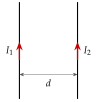
Wire 1 makes the field of an infinite line current (Section 4.1), and wire 2 feels it through . Choose the coordinates so that the cross product is a one-liner.
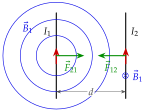
Put wire 1 on the -axis and wire 2 parallel to it at , both carrying their current in the direction (Figure 4.2.16a).
Ampère's law on a circle of radius round wire 1 gives , so that at the position of wire 2
since on the positive -axis the azimuthal unit vector is (the field of a current circulates anticlockwise seen from , so at a point on the side it points along ).
For a thin wire , and Eq. (4.2.14) gives per unit length
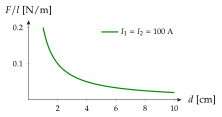
Drag one wire and watch follow . Try 100 A at 1 cm.
The minus sign points the force on wire 2 towards wire 1 (along ): parallel currents attract. Repeating the argument for wire 1 in the field of wire 2, which at wire 1 is , gives per unit length, so Newton's third law is satisfied, . If one current is reversed the product changes sign and the wires repel. Units: is (H/m)(A)/m (J/A)(A)/m N/m. The law has no length scale of its own, so it never saturates: at gives , at only , but at and it is , which is why bus-bars are braced (Figure 4.2.16b). The formula was the definition of the ampere until 2019: two wires apart carrying attract with exactly per metre.