Section 4.2 · Home exercises · 1 of 4
Home exercise 4.2.1: Coaxial cable
Coaxial cable
#A coaxial cable consists of an inner conductor of radius and a thin outer conductor of radius , with air between them. The inner conductor carries a current along its axis and the outer conductor returns it. Using Ampère's law, find in the region , then compute the magnetic flux crossing a strip of unit length between the two conductors and obtain the self inductance per unit length of the cable.
Source: B. M. Notaroš, Electromagnetics, Example 7.4.
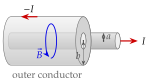
Cylindrical symmetry: Ampère's law on a circle gives the field between the conductors. The flux per unit length is the integral of over a radial strip, and the circuit links it once.
By symmetry . Ampère's law on a circle of radius , , encloses only the inner current:
Outside the cable () the enclosed current is and .
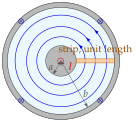
Take the strip of unit length (along ) stretching radially from to (Figure 4.2.21). is normal to it, so
This flux links the circuit formed by the inner and the outer conductor once ().
Vary : grows only logarithmically.
Units: is in H/m and the logarithm is dimensionless. From the energy:
the same. For (a common RG-type cable) . With , Eq. (3.4.29), the product does not depend on the radii at all: this is the signal speed of Chapter 5. The current inside the inner conductor adds the small internal inductance (Exercise 4.2.6).