Section 4.2 · Further exercises · 7 of 10
Exercise 4.2.7: Mutual inductance of two distant coaxial loops
About the further exercises of Section 4.2
Ten further exercises in the spirit of Problems 4.2.1–4.2.5, the worked examples and the home exercises, graded from easy to harder. Exercises 4.2.1–4.2.3 are about magnetic media and the boundary conditions, Exercises 4.2.4–4.2.5 about Ohm's law and the Joule phenomenon, Exercises 4.2.6–4.2.8 about inductance and energy, and Exercises 4.2.9–4.2.10 about dipoles and coupled circuits. They use only
As in the lectures, carries the units of (tesla), so is the magnetisation in A/m.
Mutual inductance of two distant coaxial loops
#cf. the magnetic dipole
Two circular loops are coaxial: loop 1 has radius , loop 2 has radius , and their centres are apart. (a) Using the dipole field of Section 4.2.8, find on the axis at the distance for a current . (b) Find and . (c) Which way would you compute , and why must it be the same?
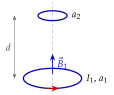
With the big loop is a point dipole, and on its axis Eq. (4.2.36) gives a uniform field over the small loop. is then field times area.
Since , loop 1 is a dipole . On its axis and the dipole field, Eq. (4.2.36), reduces to
Over the small loop 2 () this field is uniform, so
would be the flux of the small loop through the large one per ampere, an integral of a non-uniform field over the big loop. By reciprocity (the formula is symmetric in , anyway), so one always computes the mutual inductance the easy way round: field of the big loop, flux through the small one.
The exact on-axis field of a loop, (Section 4.1), differs from the dipole value by the factor here. : this is why inductive links (wireless chargers, RFID) work only over a few centimetres. With of order for such loops, here. At the formula is no longer accurate, but rises to a few tenths.