Section 4.2 · Problems · 3 of 5
Problem 4.2.3: The infinitely long solenoid
The infinitely long solenoid
#Determine the magnetic flux density inside an infinitely long solenoid with air core having closely wound turns per unit length and carrying a current as shown in the figure. Find the inductance per unit length.
Source: D. K. Cheng, Field and Wave Electromagnetics, 2nd ed., Examples 6-3 and 6-15.
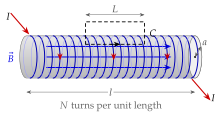
Symmetry first: the field inside is axial. Then Ampère's law on a rectangle with one side inside and one outside the winding, where the field is zero. The inductance follows from the recipe of Section 4.2.4.
Nothing depends on or , and with no dependence forbids a radial component (a radial would give unless , which is singular on the axis), so . Outside, must vanish as , and Ampère's law on a rectangle lying wholly outside encloses no current, so has the same value at every outside: everywhere outside.
Apply to the rectangle of length with one long side inside and one outside. The two radial sides cancel each other (), the outer side contributes nothing, and the contour links turns:
With the cross-section each turn links , and a length of the coil contains turns:
![Problem 4.2.3. The field on the axis of a real solenoid of length \ell=10a, B_z=\tfrac12\mu_0NI\,[\cos\alpha_1+\cos\alpha_2] with \alpha_{1,2} the angles subtended by the two ends (Section 4.1), compared with the ideal value. It stays within about 2\,\% of its centre value over the middle half, falls to very nearly half the ideal value at each end, and dies away outside.](/figures/c4-327.svg)
Check , then shorten the coil and compare with the finite-coil value.
is independent of inside and of the coil radius: the same for a thin or a fat solenoid. Units: is (H/m)(1/m)(A) (Vs/A/m)(A/m) Vs/m T. The jump of from inside to outside is exactly the first boundary condition, Eq. (4.2.11), with the sheet current of the winding. With a core of permeability both and are multiplied by , Eq. (4.2.21). For a finite solenoid the result is an upper bound: Figure 4.2.18 shows that falls to half the ideal value at each end, and the inductance of a finite coil is times the Nagaoka coefficient, which tends to only when the length is much larger than the radius. This is why Worked example 4.2.2 uses a solenoid ten times longer than its radius.