Section 4.2 · Topic 3 of 10
4.2.3 Magnetostatic boundary conditions
Real devices are made of several media: the iron core of a transformer and the air around it, the pole piece of a loudspeaker and its gap. At the surface where two media meet, jumps, and so may the fields. As in Section 3.4 the differential equations cannot be applied across such a surface, but the integral forms can, and from them we now derive how and on the two sides of an interface are related. The plan is the same as for the electric field: a small loop straddling the interface tells us about the tangential components, and a small pillbox about the normal components.
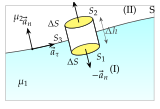
Let the surface S separate medium 1, of permeability (region I), from medium 2, of permeability (region II). At a point of S let be the unit normal pointing from medium 1 into medium 2 and a unit vector tangent to S (Figure 4.2.7). Near S we decompose the fields into tangential and normal components,
and label the values just below S (in medium 1) with the subscript 1 and those just above S (in medium 2) with the subscript 2. The interface may carry a free surface current [A/m], flowing in a thin sheet along S, as the winding of a solenoid or the current on the surface of a good conductor does.
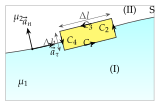
The tangential component of H
Apply the first fundamental equation in integral form, , to the small rectangular loop C of Figure 4.2.7a. The surface bounded by is the rectangle , and its normal, by the right-hand rule for the sense , is , the direction perpendicular to the loop. Now let the loop shrink onto the interface, , keeping fixed but small enough for the fields to be constant along each side.
-
On the right-hand side, a finite volume current density gives . A surface current on S, however, is caught by the loop however thin the loop is. Its component along the normal of the loop, which we call , contributes :
-
On , in medium 1 and traversed along , and
-
On and the field is finite while the path length tends to zero:
-
On , in medium 2 and traversed along ,
Adding the four pieces and equating to the right-hand side,
and since ,
where is the component of the free surface current density along , the normal of the loop. In vector form, .
The tangential component of jumps across an interface by exactly the free surface current flowing there, at right angles to the component considered. Where there is no surface current, which is the case at the surface of every magnetic material that is not also a winding, is continuous. Compare , Eq. (3.4.16): the electric field had no "surface current" to jump by.
The sign convention is worth a second look. Take and , so that the loop lies in the -plane with its normal . Then Eq. (4.2.11) says : a sheet current flowing along makes the -component of larger below the sheet than above it. This is just the field of a current sheet, on the two sides, directed by the right-hand rule, and the infinitely long solenoid of Problem 4.2.3 is the standard example: inside, outside, and the jump is the sheet current of the winding.
The normal component of B
Apply the second fundamental equation, , to the small pillbox of Figure 4.2.7b, with faces parallel to S and side of height . Again let .
-
On the face , in medium 1, the outward normal is , so
-
On the face , in medium 2, the outward normal is :
-
The area of the side is proportional to , so its flux tends to zero.
Hence
and therefore
The normal component of is always continuous: no exception, no surface current, no "magnetic surface charge". Flux lines that enter an interface must come out on the other side, because everywhere. The normal component of , on the other hand, jumps by the ratio . Compare , Eq. (3.4.17): free surface charge exists, free magnetic surface charge does not.
| First boundary condition | Second boundary condition |
|---|---|
(all on S, and at the surface of a material that carries no winding)
Writing or at the interface between iron and air. It is that is continuous and (without surface current). At the surface of a core with , jumps by a factor of and by the same factor. The pair that is continuous is exactly the pair in which the fundamental equations are written: the flux of and the circulation of .
Boundary conditions at work: the refraction of B
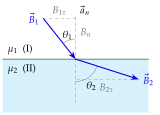
Let a line of cross an interface without surface current, making the angle with the normal in medium 1 and in medium 2 (Figure 4.2.8a). The components are and , and the two boundary conditions give
Dividing the second by the first,
On entering the medium of higher a line of bends away from the normal, and the more so the larger . This is the magnetic twin of the refraction law, Eq. (3.4.18), of the electric field lines, with replaced by .
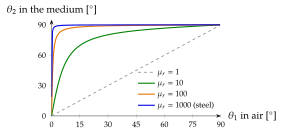
. For steel (), a line arriving from the air only off the normal already runs at inside the iron. Reversing the trip, flux leaving iron into air comes out practically normal to the surface, whatever its direction inside: , so even a line running at inside the iron leaves at less than from the normal. This is why a magnetic circuit behaves like a wire circuit: the flux stays in the iron and crosses an air gap straight, at right angles to the pole faces (Worked example 4.2.1, Exercise 4.2.8). Exercise 4.2.3 works the refraction out numerically for a pair of media with and .
Drag inside the iron towards 89° and watch the flux still leave almost along the normal, then try air to steel.
in air makes with the surface of an iron plate of . What angle does it make with the normal inside the iron, and what is the ratio ?
, : the line runs along the plate. The normal component is unchanged, , and the tangential one is multiplied by , so .