Section 4.2 · Further exercises · 1 of 10
Exercise 4.2.1: A uniformly magnetised rod
Ten further exercises in the spirit of Problems 4.2.1–4.2.5, the worked examples and the home exercises, graded from easy to harder. Exercises 4.2.1–4.2.3 are about magnetic media and the boundary conditions, Exercises 4.2.4–4.2.5 about Ohm's law and the Joule phenomenon, Exercises 4.2.6–4.2.8 about inductance and energy, and Exercises 4.2.9–4.2.10 about dipoles and coupled circuits. They use only
As in the lectures, carries the units of (tesla), so is the magnetisation in A/m.
A uniformly magnetised rod
#cf. what M describes
A long cylindrical bar magnet of radius and length is uniformly magnetised along its axis, with . (a) Find the bound volume current and the bound surface current . (b) Which solenoid produces the same field, and how many ampere-turns per metre does it carry? (c) Estimate and at the centre of the rod, far from the ends.
Adapted from: B. M. Notaroš, Electromagnetics, Example 5.3.
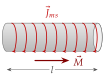
Apply Eq. (4.2.5) to a uniform : no volume current, a sheet current on the curved surface. That sheet is a solenoid, and Problem 4.2.3 gives its field.
is uniform inside, so in the volume. On the curved surface the outward normal is and
On the two end faces is parallel to and .
A sheet current on a cylinder is exactly a tightly wound solenoid with ampere-turns per metre: the magnet is equivalent to a solenoid of the same size carrying ampere-turns per metre, for example turns per metre at .
In the middle of a long solenoid (Problem 4.2.3, here ) :
Units: is T/(H/m) (Vs/m)(Am/(Vs)) A/m. Inside a long magnet although is large: comes from the bound current, only from free currents, and there are none. Near the ends the lines of leak out, drops to about at the faces (the half-value of Figure 4.2.18), and becomes a demagnetising field pointing against (Figure 4.2.4). A short, fat magnet therefore needs a material with a large coercive field, a permanent-magnet material, to stay magnetised.