Section 4.2 · Problems · 5 of 5
Problem 4.2.5: DC motor
DC motor
#DC Motor: . The rectangular loop rotates around the -axis. Assignment: How can we make this rotate infinitely?
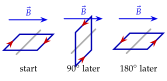
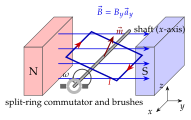
Put an angle on it: describe the position of the loop by its rotation angle about the shaft, write , and use of Problem 4.2.4. The sign of the torque as a function of answers the assignment.
Let the loop have the area and let be the angle of rotation about the -axis measured from the position in which the loop lies in the -plane with . Rotating about by gives , so
- is largest at , where and the loop lies along the field (the "start" position of the figure).
- at and at , the two dead points. For the torque is negative, so from the loop turns towards smaller , that is towards (), where is parallel to : the stable position of least energy. At the other dead point, , the moment is antiparallel to , an unstable position.
- The loop coasts through on its inertia, and there changes sign: the torque reverses and now brakes. With a fixed current the loop cannot complete the turn. It oscillates about and settles there (Figure 4.2.20).
Reverse the current every half turn, at the dead points, so that flips whenever changes sign. Then always has the same sign and the loop keeps turning, in the sense of decreasing . Mechanically this is the split-ring commutator with its brushes, drawn on the shaft in the figure: the two half-rings exchange their brushes every half turn. Electronically it is the inverter bridge of a brushless DC motor, switched by a position sensor.
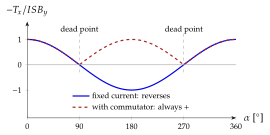
Run it without a commutator and see the loop settle at the stable dead point, then switch the commutator on.
At the result reduces to Problem 4.2.4 with and (the current here circulates anticlockwise seen from ), , as found. One loop still pulses between zero and . Real armatures carry many loops and many commutator segments, which fill in the dips, and the mean torque is proportional to : this is the motor constant of the DC machine.