Section 4.2 · Worked examples · 2 of 3
Worked example 4.2.2: Two coaxial coils: the mutual inductance and the coupling
About the worked examples of Section 4.2
Three short calculations tied to the applications. They use only , and the Lorentz force , and no new physics. Numerical constants: , . A good way to use them: read the given quantities, produce the formula from the corresponding application or problem yourself, and only then put the numbers in.
Two coaxial coils: the mutual inductance and the coupling
#cf. Application 4.2.2
Given. Primary: a long air-cored solenoid, , turns, radius (). Secondary: turns wound tightly over the middle of it.
Find. (a) , (b) , (c) , (d) , (e) the voltage induced in coil 2 when .
Adapted from: D. K. Cheng, Field and Wave Electromagnetics, 2nd ed., Example 6-18.
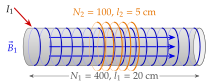
From Problem 4.2.3, inside a long solenoid and . The mutual inductance is the flux of coil 1 that coil 2 links, per ampere of : (Figure 4.2.23).
, and
All of crosses the secondary, so and :
The short coil is itself a solenoid of length (end effects neglected):
. In symbols, .
(Faraday's law, Chapter 5).
Reciprocity: compute the other way round. Coil 2 makes only over its own , where it is crossed by turns of coil 1, so . Although every line of the primary crosses the secondary, is only : the short coil's own flux escapes along the rest of the long one, and that part of is not shared.