Section 4.2 · Topic 8 of 10
4.2.8 Magnetic dipole and torque
The field of a small current loop
The atomic current loops of Section 4.2.1 and the coils of every motor and meter are closed loops of current in a magnetic field. We now look at the smallest building block, a plane circular loop of radius carrying , first as a source and then as the object of a torque.
Let the loop lie in the -plane, centred at the origin, with the current (Figure 4.2.14a). The vector potential at a point P far from the loop () was found in Section 4.1 to be
The combination , current times area, is all that remains of the loop. We define the magnetic dipole moment
directed along the normal of the loop. Consider that (the angle between and is , and their cross product is along ). Then Eq. (4.2.34) and its curl take the forms
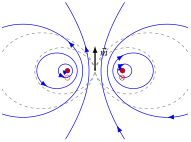
Far away, a current loop looks like a magnetic dipole: its field has exactly the shape of the field of the electric dipole of Section 3.3, , with replaced by , and it falls off as . Figure 4.2.14b shows that already at a few radii the lines of the loop are indistinguishable from dipole lines.
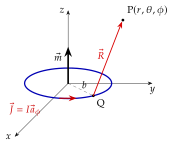
A general formula for the magnetic dipole moment of a plane loop of any shape is
where is the area the loop encloses and follows the right-hand rule from the sense of : curl the fingers along the current and the thumb gives . For a coil of turns, .
Torque on a dipole
Place the loop in a uniform field . The forces on opposite sides of the loop are equal and opposite, so the net force is zero, but they do not act along the same line: they form a couple that tries to turn the loop until its normal lines up with . The torque is
of magnitude , where is the angle between and , and directed so as to turn towards .
Also, we can always determine the torque directly from the forces by
where is the position vector of the point of application of the force with respect to the spinning point. Problem 4.2.4 does exactly this for a rectangular loop in an arbitrary uniform field, side by side, and recovers Eq. (4.2.38). Because any plane loop can be cut into thin rectangles whose inner sides cancel, the result holds for a loop of any shape.
The torque on one loop: turn the coil and see vanish when lines up with .
A current loop in a magnetic field behaves like a compass needle: it is twisted until its moment points along the field, with the torque , largest when the loop lies along the field lines () and zero when its normal is already aligned. This is the DC motor of Problem 4.2.5, the moving-coil meter and the compass of Exercise 4.2.9 in one formula.
A circular coil of turns and radius carries in a field of . What is its magnetic moment, and the largest torque it can feel?
, and , when the plane of the coil is parallel to .
The component of along the normal of the loop produces no torque at all: it only pulls the sides of the loop outward (or inward) and tries to stretch it. Only the component of lying in the plane of the loop twists it, (Problem 4.2.4).
The loudspeaker is the Lorentz force made useful (Figure 4.2.15). A permanent ring magnet, a soft-iron back plate, a cylindrical pole piece and a top plate make a radial field in a narrow annular gap. In the gap sits the voice coil: turns of radius on a light former glued to the cone. Each element of the coil sits in , so is axial, , with the same sign all round every turn. Adding the elements,
Nothing but the Lorentz force of Section 4.1: the geometry of the gap does the rest.
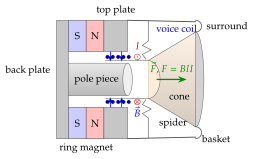
- is the force factor [Tm N/A], to in hi-fi drivers. Reverse and reverses: an alternating current moves the cone in and out at the signal frequency and pushes the air.
- is radial everywhere in the gap, so does not depend on where the coil sits along the axis, as long as it stays in the gap: a linear motor, just as a radial gap gives the moving-coil meter its linear scale.
- The field does not bring the cone back. The spider and the surround centre the coil in the gap and supply the restoring force. Together with the moving mass they fix the resonance frequency of the driver.
- The gap is kept narrow (about ) and the iron path short. By the refraction rule, Eq. (4.2.13), flux leaves the iron practically normal to its surface, so the top plate and the pole piece hand it across the gap radially, which is exactly the field the coil needs.
Worked example 4.2.3 puts numbers in: a gap, turns of radius and give and , enough to accelerate a cone at .
A voice coil has and the moving mass is . What peak current gives a peak acceleration of ?
, so .
Table 4.2.3. The applications of this section.
| Application | Physics used | Worked out in |
|---|---|---|
| Ferromagnetic materials | , saturation, the air gap | Worked example 4.2.1 |
| Transformers, coupling | , | Worked example 4.2.2, Exercise 4.2.10 |
| The loudspeaker | in a radial gap | Worked example 4.2.3 |