Section 4.2 · Further exercises · 5 of 10
Exercise 4.2.5: Radial current in a hollow cylinder
About the further exercises of Section 4.2
Ten further exercises in the spirit of Problems 4.2.1–4.2.5, the worked examples and the home exercises, graded from easy to harder. Exercises 4.2.1–4.2.3 are about magnetic media and the boundary conditions, Exercises 4.2.4–4.2.5 about Ohm's law and the Joule phenomenon, Exercises 4.2.6–4.2.8 about inductance and energy, and Exercises 4.2.9–4.2.10 about dipoles and coupled circuits. They use only
As in the lectures, carries the units of (tesla), so is the magnetisation in A/m.
Radial current in a hollow cylinder
#cf. Ohm's law
A hollow cylinder of inner radius , outer radius and length is made of a poorly conducting material, . Its inner and outer surfaces are coated with metal, and a current flows radially from the inner to the outer surface. Find (a) and inside the material, (b) the voltage between the electrodes and the resistance, (c) the dissipated power, from and from .
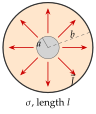
The current is conserved: the same crosses every coaxial cylinder, which fixes by symmetry. Ohm's law gives , its line integral the voltage, and the Joule integral must be done over the shells .
In the steady state the same current crosses every cylinder of radius (charge conservation), and by symmetry is radial and uniform over the cylinder of area :
At : and . At they are five times smaller.
, integrated over :
Compare the coaxial capacitor, Eq. (3.4.29), : , independent of the geometry. The same field pattern serves both: replace by and by . This is the leakage resistance of a cable's insulation, and the principle of the resistive earth electrode.