Section 4.2 · Further exercises · 6 of 10
Exercise 4.2.6: Internal inductance of a wire
About the further exercises of Section 4.2
Ten further exercises in the spirit of Problems 4.2.1–4.2.5, the worked examples and the home exercises, graded from easy to harder. Exercises 4.2.1–4.2.3 are about magnetic media and the boundary conditions, Exercises 4.2.4–4.2.5 about Ohm's law and the Joule phenomenon, Exercises 4.2.6–4.2.8 about inductance and energy, and Exercises 4.2.9–4.2.10 about dipoles and coupled circuits. They use only
As in the lectures, carries the units of (tesla), so is the magnetisation in A/m.
Internal inductance of a wire
#cf. Home exercise 4.2.1
A long straight wire of radius carries the current uniformly over its cross-section. (a) Find inside the wire. (b) From the magnetic energy stored inside the wire per unit length, find the internal inductance per unit length. (c) For the coaxial cable of Home exercise 4.2.1 with and , compare the internal and the external inductance per metre.
Adapted from: B. M. Notaroš, Electromagnetics, Example 7.25.
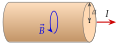
Inside the wire the flux lines link only part of the current, so "flux per ampere" is ambiguous. The energy sidesteps the question.
Ampère's law on a circle of radius encloses the fraction of the current:
Energy per unit length inside the wire, with per metre:
Setting this equal to ,
External part (Home exercise 4.2.1): . Total , of which the internal part is .
Units: is in H/m, so is an inductance per unit length. The flux method is awkward here because the inner flux lines link only part of the current, and the energy method sidesteps the question of what links what. At high frequency the current crowds to the surface (the skin effect of Chapter 5), the field inside vanishes and so does : the inductance of a cable is slightly smaller at radio frequencies than at DC.