Section 4.2 · Further exercises · 9 of 10
Exercise 4.2.9: Compass needle in the Earth's field
About the further exercises of Section 4.2
Ten further exercises in the spirit of Problems 4.2.1–4.2.5, the worked examples and the home exercises, graded from easy to harder. Exercises 4.2.1–4.2.3 are about magnetic media and the boundary conditions, Exercises 4.2.4–4.2.5 about Ohm's law and the Joule phenomenon, Exercises 4.2.6–4.2.8 about inductance and energy, and Exercises 4.2.9–4.2.10 about dipoles and coupled circuits. They use only
As in the lectures, carries the units of (tesla), so is the magnetisation in A/m.
Compass needle in the Earth's field
#cf. magnetic dipole and torque
A compass needle has the magnetic moment and the moment of inertia about its pivot. The horizontal component of the Earth's field is . (a) Find the torque when the needle makes with . (b) Find the potential energy and the work needed to turn the needle from the aligned to the reversed position. (c) Show that small oscillations about the aligned position are harmonic and find their frequency.
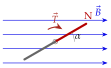
A compass needle is a dipole: . The potential energy whose derivative gives this torque is , and for small the equation of motion is that of a pendulum.
, directed so as to turn towards .
. The torque is , restoring, as it should be. From to ,
The equation of motion for small is that of a harmonic oscillator:
Units: is (Am)(T) (Am)(Vs/m) J, and s. Measuring the oscillation period is the classical way of determining (Gauss's method): with known from the needle's mass and shape, follows. A real compass is damped, by fluid or by eddy currents in a copper bowl, so that it settles instead of swinging.