Section 6.2 · Topic 5 of 9
6.2.5 Skin depth and surface resistance
The skin depth falls as . For copper, , it is
Figure 6.2.7. Seawater follows the same line up to some tens of megahertz and leaves it near , where it stops being a good conductor and levels off at the low-loss value .
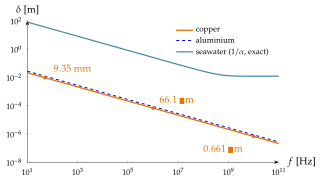
Slide below from to and watch the skin depth of copper shrink as , from to , while .
Why the current crowds to the surface
A wave entering a conductor drives a current which, like the field, decays as . In circuit language this is the skin effect: the eddy currents induced by the changing magnetic field (Faraday's law, Section 5.3) oppose the current in the interior of a conductor and push it to the surface. The faster the field changes, the thinner the layer that carries the current.
Surface resistance
A conductor much thicker than behaves as if a sheet of thickness carried the whole current uniformly. Its resistance per square, a piece of surface as long as it is wide, is the surface resistance.
and a round wire of radius and length , whose current flows in a layer of thickness around the circumference , has
At high frequency a thick conductor carries its current only in a skin of thickness , and its resistance is that of this skin. The resistance therefore grows as .
That is truly the resistance of the wall, and not only a convenient name, is shown in Exercise 6.2.5: the total current per unit width flowing in a thick wall equals the tangential at its surface, and the power entering the wall is per square metre. This is the recipe for the losses of every waveguide and cavity of Chapter 7.
Litz wire, made of many thin insulated strands, gives each strand a radius below and so restores the full cross-section at audio and low radio frequencies. Large high-current conductors are made hollow, since the interior carries nothing. Waveguides are silver plated a few skin depths thick: the plating carries all the current and the brass underneath only gives shape (Worked example 6.2.2). Shielding (Problem 6.2.4) and induction heating (Exercise 6.2.4) are the skin effect put to use.
By what factor does the a.c. resistance of a thick copper wire grow from to ?
: by . Worked example 6.2.2 gives and for one metre of wire of radius .
A message to a submerged submarine has to travel through seawater, and seawater (, ) has , so that
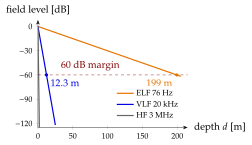
Below about this exceeds and the sea is a good conductor. A wave entering it from the surface decays with the skin depth, and the loss after a depth is
Table 6.2.2 and Figure 6.2.8 show what this means. With a receiver that tolerates less than the field just below the surface, a signal is lost after one metre, a VLF signal at reaches and an ELF signal at reaches .
Table 6.2.2. Seawater () as a good conductor.
| (ELF) | (VLF) | (HF) | |
|---|---|---|---|
| dB/m | |||
| depth for |
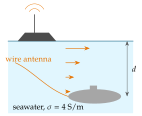
The price of depth is bandwidth. Only frequencies far below get through, and a carrier of some kilohertz or some tens of hertz can carry very little information: VLF broadcasts carry a few hundred bits per second, tens of characters per second, ELF only a few characters per minute. A submarine therefore listens near periscope depth on a trailing wire antenna (VLF), or receives a short ELF "call me" message at depth and comes up to receive the rest.
VLF shore stations work at to with antenna masts several hundred metres high, for example the US Navy's Cutler station in Maine at . ELF needs antennas that are tens of kilometres long: the US Navy's system in Wisconsin and Michigan (closed in 2004) and the Russian ZEVS at used ground electrodes tens of kilometres apart. At the wavelength in air is , but in the sea it is only , and the same margin reaches instead of at VLF.