Section 7.1 · Topic 3 of 10
7.1.3 TEM, TM and TE waves
The formulas (7.1.11) split every guided wave into three families, according to which of the generating fields is present.
- TM waves (transverse magnetic, or E waves): , . They are generated by .
- TE waves (transverse electric, or H waves): , . They are generated by .
- TEM waves (transverse electromagnetic): . A nonzero transverse field then requires , that is , and the wave travels with the speed of the filling at every frequency.
A general field in the guide is a sum of TM and TE modes, plus TEM if it exists.
The last item needs a word of explanation. If , the right-hand sides of Eq. (7.1.11) vanish, and a nonzero transverse field is possible only if the factor on the left vanishes as well. Then Eq. (7.1.10) gives : the TEM wave has the phase constant of a plane wave in the filling. Figure 7.1.3 shows one member of each family for the parallel-plate guide of Section 7.2.
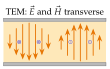
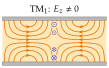
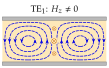
With the reduced equations (7.1.12) for the transverse field become Laplace's equation in the cross-section, exactly as for an electrostatic field (Section 3.3.5). Inside a single closed conductor such a field is zero, just as the electrostatic field inside a hollow conductor is zero. A TEM wave therefore needs two conductors at different potentials: the parallel plates, the coaxial cable, the two-wire line.
For a TEM wave has the component , and since . A transverse field that is both curl-free and divergence-free in the cross-section is the gradient of a potential, , with . On a perfect conductor the tangential vanishes, so each conductor is an equipotential. If there is only one conductor, enclosing the whole cross-section, is constant on the boundary of the region, the solution of Laplace's equation is that constant everywhere, and . With two separate conductors can take two different values, and a nonzero TEM field exists: it is the electrostatic field of the two-conductor capacitor, travelling along with .
Putting into Eq. (7.1.11) and concluding that the TEM field is zero. The formulas were obtained by dividing by , which is zero for TEM, so they say nothing about it. The TEM field is found instead from the two-dimensional electrostatic problem of the deeper box above.