Section 7.1 · Topic 4 of 10
7.1.4 Cutoff frequency and guide wavelength
The boundary conditions on the walls allow only discrete values of , one for each mode, and these values depend on the shape and size of the cross-section only (Section 7.2 finds them for two plates, ). For a given mode, Eq. (7.1.10) gives
which is real only if . The frequency at which , that is , is the cutoff frequency of the mode. Writing ,
- : is real and the mode propagates as .
- : . Choosing the root that decays in the direction of travel, with , the field varies as . It does not oscillate along , it only decays: the mode is evanescent, and no power travels (Section 7.1.7).
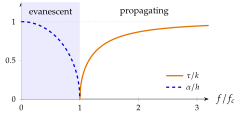
Figure 7.1.4 plots both. The phase constant rises from zero at cutoff towards , and the attenuation constant falls from at low frequency to zero at cutoff.
The period of the field along is the guide wavelength,
A mode exists only above a frequency set by the size of the guide. Just above cutoff and : the field hardly changes along the guide. Far above cutoff and . Below cutoff the field does not travel at all, it dies away exponentially. The cutoff wavelength is the wavelength in the filling at , and the mode propagates when .
Using the wavelength of the filling for distances along the guide, for instance between two maxima of a standing wave or for the length of a quarter-wave section. Along the guide the field repeats after , which is always longer than (Home exercise 7.2.1 in Section 7.2 shows how is measured).
An air-filled guide carries a mode with at . Find and .
and , so .
A mode is driven at half its cutoff frequency. By how many decibels does its field fall over one cutoff wavelength ?
with , so , that is . Evanescent fields die within a fraction of a cutoff wavelength.