Section 7.1 · Topic 5 of 10
7.1.5 Phase and group velocity in a guide
The speed of a point of constant phase of is the phase velocity
The envelope of a signal, and with it the energy, travels at the group velocity (Section 6.2). Differentiate , in which is fixed by the geometry and does not depend on :
The crests run along the guide faster than light in the filling, the energy slower, and the product of the two speeds is always . At cutoff the energy stands still () while the crests race ().
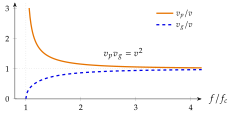
depends on frequency, so the spectral components of a pulse arrive at different times and the pulse spreads (Application 7.1.1). This waveguide dispersion is caused by the geometry alone. It appears even with a perfectly non-dispersive filling, in air. The TEM wave, with , is not dispersive: .
In an air-filled guide . This carries no information and no energy, and it does not conflict with relativity. Information and energy travel at , and at cutoff. Section 7.2 shows with the zig-zag picture where the two speeds come from.
In an air-filled guide a mode has . What are and ?
, and gives , so .