Section 7.8 · Topic 15 of 18
7.8.15 Scattering parameters
At microwave frequencies it is difficult to measure a voltage or a current directly, and in a hollow guide they are not even uniquely defined. What can be measured is the incident and the reflected wave at each port. A component is therefore described as an -port network that relates the outgoing waves to the incoming ones (Figure 7.8.19). For a two-port,
The wave amplitudes (incident) and (outgoing) are defined at the reference plane of port so that the incident power is and the reflected power . In a guide are defined by the amplitudes of the TE fields. is the input reflection coefficient (the matching), the forward transmission (gain or loss).
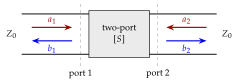
with all other ports matched ( for ): feed port , terminate every other port in its characteristic impedance, and measure what comes out of port .
Matched loads are easy to make at microwave frequencies. The open and short circuits needed for the impedance and admittance parameters of circuit theory are not, and they could make an active device oscillate. This is why the scattering parameters, and the network analysers that measure them, are the language of microwave engineering. The usual quantities in decibels are
the return loss, the insertion loss and the voltage standing-wave ratio of Section 6.3.
- Reciprocal (no ferrite, no active device): , the matrix is symmetric.
- Lossless: power in power out, . Every column has unit length and different columns are orthogonal. For a lossless two-port .
- Matched at port : .
A lossy two-port fed at port 1 absorbs the fraction of the incident power.
| Component | |
|---|---|
| Matched attenuator | |
| Ideal isolator | |
| Ideal circulator |
The attenuator is reciprocal and lossy: it absorbs of the power. The isolator is matched and non-reciprocal. The circulator is matched, lossless (its columns are orthonormal) and non-reciprocal. Exercise 7.8.7 shows that a lossless reciprocal three-port can never be matched at all three ports, which is why the circulator needs a ferrite.
A two-port has and . Find the return loss, the insertion loss, the VSWR and the fraction of the incident power it absorbs.
, , , and it absorbs , that is of the incident power.