Section 7.5 · Topic 5 of 8
7.5.5 The best ratio b/a: minimum loss, maximum power
Keep the outer radius fixed (it is set by size, weight and the frequency limit) and vary . With , Eq. (7.5.13) and Eq. (7.5.11) become
- Minimum loss: gives , solved by , .
- Maximum power: gives , , .
- Highest voltage ( smallest for a given , or largest): , , (Exercise 3.3.10 of Section 3.3).
| optimum | condition | in air | |
|---|---|---|---|
| minimum loss | |||
| maximum power | |||
| highest voltage |
(air: ) is the compromise.
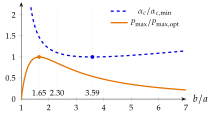
An air line at loses only more than the minimum-loss line and carries of the maximum power. With polyethylene the minimum-loss line has : is also very nearly the lowest-loss solid cable. , the television standard, is close to the air-line optimum , and receiving systems care about loss, not power.
Why does a fat inner conductor give high power but not low loss?
A fat inner conductor spreads the surface field over a large radius, so is small for a given voltage and much power can pass before breakdown. But a fat inner conductor means a small , a low and therefore a large current for a given power, , and the loss grows with . A thinner one raises , so the same power needs less current, until the growth of the inner-conductor loss takes over at .