Section 7.6 · Topic 1 of 14
7.6.1 Guiding by total internal reflection
Consider a uniform plane wave travelling inside a layer of refractive index , bounded above and below by a medium of lower index . It meets a face at the angle measured from the normal. Section 6.4 showed that beyond the critical angle
the wave is totally reflected: the reflection coefficient has magnitude one and only its phase depends on the angle. A wave launched at is therefore reflected without loss at the upper face, travels down to the lower face, is reflected again, and zig-zags along the layer indefinitely (Figure 7.6.1). This is the principle of every dielectric waveguide.
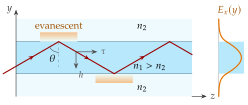
The wave vector of the zig-zagging wave has the magnitude . Split it into a component along the guide and a component across it:
Total internal reflection requires , that is , and of course gives . It is convenient to measure in units of :
The guided wave travels along with the phase velocity and the guide wavelength .
A guided wave is slower than a plane wave in the surrounding medium and faster than a plane wave in the core. It travels as if it were in a uniform medium of an intermediate index, , which lies closer to the more of the field is inside the core.
The field outside
Phase matching at the faces (Snell's law of Section 6.4) requires the same variation outside the layer. A wave of wavenumber with the longitudinal component must have a transverse component with , an imaginary with
Outside the layer the field therefore decays as away from the faces: it is the evanescent wave of total internal reflection. It is a real field, which can be measured and which couples to anything brought close, but its electric and magnetic tangential components are out of phase, so no time-average power crosses the faces. All the power flows along .
Not every angle
The upward and the downward plane waves overlap in the layer. As they travel along they must reproduce the same transverse pattern after each round trip, otherwise they would cancel by interference. Only a discrete set of angles satisfies this self-consistency condition. Each of them defines a mode of the guide, with its own . Sections 7.6.2–7.6.5 find these angles from Maxwell's equations, and Section 7.6.8 finds them again from the ray picture.
A glass layer, , is surrounded by air. What is the critical angle, and what is the effective index of a wave that zig-zags at ?
. At the wave is totally reflected and , between and as Eq. (7.6.3) requires. (Whether is one of the allowed mode angles depends on the thickness and the frequency.)