Section 7.6 · Topic 8 of 14
7.6.8 The ray picture: transverse resonance
The modes were found from Maxwell's equations. The same eigenvalue equations follow from the ray picture of Section 7.6.1, and this second derivation explains what the modes are.
The phase of total reflection
The upgoing wave meets the upper face at the angle from the normal. For a TE mode the wave is perpendicularly polarised, and Section 6.4 gives
Beyond the critical angle , and is imaginary. The transmitted wave must decay into the upper medium, which fixes with . Then
since numerator and denominator are complex conjugates: , and only the phase is left. With , by Eq. (7.6.4), and by Eq. (7.6.2),
(The transmitted wave decays as : the evanescent field of the ray picture is exactly the tail of the mode.)
The round trip
Follow a wavefront of the upgoing wave once around: it crosses the slab upwards (phase ), is reflected (phase ), crosses downwards () and is reflected again (), Figure 7.6.7. The wave reproduces itself, and the up- and down-going waves reinforce instead of cancelling, only if the total phase is a multiple of :
Take the tangent of and use Eq. (7.6.28):
the TE equations Eq. (7.6.20) again. With of the parallel polarisation the same steps give the TM equations.
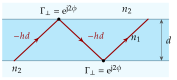
In the field picture a mode is a standing wave across the guide and a travelling wave along it. In the ray picture it is a pair of plane waves zig-zagging at , with
For the TE mode of Problem 7.6.1, and give , well beyond the critical angle . Every guided mode zig-zags beyond , because is the same statement as .