Section 7.6 · Topic 7 of 14
7.6.7 Field profiles and confinement
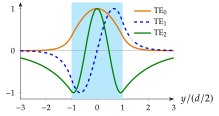
Figure 7.6.6a shows the transverse field of the three TE modes of a slab with .
- TE has zeros across the slab: a half-period more of the standing wave per order.
- Outside, the field decays as , so the decay length is . Near cutoff and the tail reaches far out. Far above cutoff , the field at the face is small, and the field clings to the slab.
- TE in Figure 7.6.6a works close to its cutoff () and spreads widely into the surrounding medium.
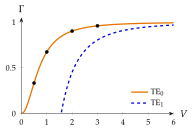
The confinement factor
By Eq. (7.6.14) the power is proportional to , since is the same everywhere. For the even mode Eq. (7.6.9), with and ,
The fraction of the power carried inside the slab is the ratio of the first integral to the sum:
For the odd TE modes and .
For TE, , , and at , , and (Figure 7.6.6b). A thin slab carries most of its power outside. For TM modes the power density is , which weights the inside by and the outside by , so Eq. (7.6.25) does not apply to them unchanged.
The evanescent field is not a nuisance but a tool. It lets two guides placed close together exchange power (directional couplers in integrated optics), it lets a sensor feel the medium just outside the guide (evanescent-wave biosensors), and it is why the cladding of an optical fibre must be many decay lengths thick: whatever touches the tail, a coating or a bend, takes power from the mode.