Section 7.6 · Topic 6 of 14
7.6.6 Cutoff frequencies and the number of modes
The branch of mode starts on the -axis, at and . There : the field outside no longer decays, the wave is no longer bound to the slab, and the mode ceases to be guided. The circle reaches the start of branch when , and since by Eq. (7.6.19):
TE and TM have the same cutoff. A slab at the normalised frequency guides
-
TE and TM have no cutoff: any slab, however thin, guides them at any frequency.
-
Only TE and TM propagate when , that is for
-
Cheng's cutoff frequencies (Table 10-4 of Field and Wave Electromagnetics) are the same numbers, and for his two families, which interleave to give Eq. (7.6.21).
The b–V diagram. How far between and does lie? The normalised propagation constant
answers this. (The second form follows from : divide by and use .) grows from at cutoff, where , towards far above cutoff, where (Figure 7.6.5). Because changes with frequency, the guide is dispersive even though both media are not.
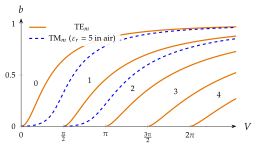
A hollow metal guide (Section 7.3) has infinitely many modes, and even its lowest mode is cut off at low frequencies, where it becomes evanescent along . A dielectric slab has a finite number of guided modes at any frequency, and TE and TM are guided down to d.c. Below its cutoff a dielectric mode is not evanescent along : its field outside the slab no longer decays ( would have to become imaginary), so it leaks sideways and radiates.
For the slab of Problem 7.6.1, and in air, and .
A polymer film of index is surrounded by air and used at . Up to which thickness does it guide only TE and TM?
and, by Eq. (7.6.23), . A film thicker than also guides TE and TM.