Section 7.6 · Topic 10 of 14
7.6.10 The step-index optical fibre
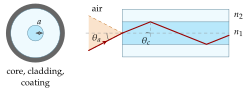
An optical fibre is a dielectric rod: a glass core of index and radius , surrounded by a glass cladding of slightly lower index and protected by a polymer coating (Figure 7.6.9). In a step-index fibre the index jumps from to at the core boundary. Light is guided in the core by total internal reflection at that boundary, exactly as in the slab, and the evanescent tail runs in the cladding.
The acceptance cone
Which rays launched from the air into the flat end face are trapped? A ray entering at the angle to the axis is refracted to the angle with (Snell's law with ). It then meets the core boundary at the angle from the normal, and it is totally reflected if . The largest accepted angle therefore belongs to :
Rays inside the acceptance cone of half-angle are trapped. The normalised frequency is that of the slab with the core radius in place of the half-thickness:
The numerical aperture is the sine of the widest angle at which light can be thrown into the fibre and still be held. It depends only on the two indices. adds the size of the core in wavelengths and decides how many modes the fibre carries.
The same construction is Example 7.5.5 of Orfanidis (Electromagnetic Waves and Antennas), which also introduces the name numerical aperture.
Glass fibres have : the index of the core is raised only slightly, by doping the silica with germanium. The critical angle is then close to and the guided rays run nearly parallel to the axis. Such fibres are called weakly guiding. Table 7.6.1 lists the three common types. All glass fibres have a cladding of diameter, many decay lengths of the evanescent tail.
Table 7.6.1. Typical step- and graded-index fibres.
| Fibre | core [µm] | , NA | Use |
|---|---|---|---|
| single-mode silica | – | , | long-haul and access links |
| multimode, graded index | , | data centres, buildings | |
| plastic (PMMA) | , | cars, home networks |
A silica fibre has and . Find NA and the acceptance angle.
and : a narrow cone, which is why light is launched into such fibres with lasers and lenses.