Section 7.6 · Topic 11 of 14
7.6.11 Modes of the fibre and the single-mode condition
The modes of the round core are found as in the circular metal guide of Section 7.4, with Bessel functions. Inside the core the fields vary as , outside as , where is the modified Bessel function of the second kind, which decays roughly as . The parameters are the radial versions of and ,
so plays the role of the slab's cosine and that of its exponential.
- The exact modes of the rod are hybrid: they have both and (they are called HE and EH modes), except the circularly symmetric TE and TM.
- When the boundary barely distinguishes TE from TM (the factor of the slab is almost ), and the exact modes group into nearly degenerate sets, the linearly polarised LP modes, whose transverse field points in one fixed direction.
- The lowest, LP (the HE mode), has no cutoff, like TE of the slab.
LP is cut off at the -th zero of , the root counted only for (so LP has no cutoff and LP starts at ). The second mode, LP, starts where , so the fibre is single-mode for
For the fibre carries about modes (counting both polarisations).
A fibre is a round slab. Its modes are named by two numbers, the number of field periods around the axis () and across the radius (). Make the core thin enough, or the index step small enough, that , and only the fundamental mode survives.
The tool below shows the single-mode fibre of Problem 7.6.3 at . Drag the launch ray out of the acceptance cone, then shorten until LP appears at , below .
For each transverse field component satisfies the scalar Helmholtz equation in cylindrical coordinates, and and are continuous at (the jump of is too small to matter). With inside and outside, continuity of the logarithmic derivative gives
The recurrence relations and turn this into , which is Eq. (7.6.37). For use and . At cutoff the right-hand side tends to zero, so the left-hand side must vanish too: , which gives the cutoff rule. The slab's even TE equation is the same statement for cosines and exponentials.
Figure 7.6.10 shows of the first six LP modes, computed from Eq. (7.6.37). The single-mode range is shaded.
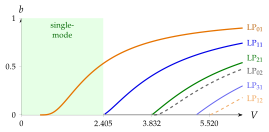
Single-mode fibre
Above the cutoff wavelength only LP propagates, in two orthogonal polarisations. All the light then travels with one , and the modal dispersion of the next subsection disappears. Standard telecom fibre has , so it is single-mode in both telecom windows, at and at . Its core is to across, and it can be that large only because the NA is small: with the NA of a multimode fibre a single-mode core would have a radius of about , far too small to couple light into (Problems 7.6.3 and 7.6.4).