Section 7.6 · Further exercises · 1 of 5
Exercise 7.6.1: How much LED light enters a fibre?
Five further exercises on dielectric waveguides, in the spirit of Problems 7.6.1–7.6.4 and the home exercises, graded from easy to harder: light launched into a fibre, a bent fibre, a coating designed for a surface wave, a measurement of permittivity with a surface wave, and a silicon photonic waveguide. They use only the relations listed at the head of this subsection and Snell's law and the Fresnel formulas of Section 6.4.
How much LED light enters a fibre?
#A surface-emitting LED with an emitting spot in diameter radiates into the half space in front of it as a Lambertian source, . It is butted against the flat end of a fibre in air, without a lens.
- Show that a fibre accepts the fraction of the power of a Lambertian spot smaller than its core.
- Find the coupled power (µW and dBm) into the plastic fibre of Home exercise 7.6.2, the multimode fibre of Problem 7.6.4 and the single-mode fibre of Problem 7.6.3. Where the spot is larger than the core, only the part facing the core counts.
- How much does the Fresnel reflection at the end face of the plastic fibre cost?
- Which NA would collect half of the LED's power?
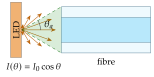
A ray reaching the end face within the acceptance cone is trapped (Section 7.6.10). Integrate the Lambertian intensity over that cone and divide by its integral over the half space. An emitting area larger than the core is weighted by the area ratio.
The solid-angle element is , so
and the accepted fraction is .
The spot radius is .
| fibre | NA | area factor | |
|---|---|---|---|
| plastic, µm | |||
| multimode, µm | |||
| single-mode, µm |
| fibre | coupled | |
|---|---|---|
| plastic | µW | dBm |
| multimode | µW | dBm |
| single-mode | µW | dBm |
At normal incidence (Section 6.3) , a loss of , small next to (b).
: , an acceptance cone of half-angle.
In decibels the single-mode case is below .
A Lambertian source spreads its power over the whole half space, and a fibre takes only the small cone . That is why LEDs are paired with large-core, high-NA plastic fibres, and why single-mode fibres need lasers, whose beam of a few degrees can be focused onto the core. For the single-mode fibre the ray estimate is only indicative: the true coupling is the overlap of the source field with the LP mode, which is lower still.
cf. Problem 7.6.3