Section 7.6 · Further exercises · 2 of 5
Exercise 7.6.2: How tightly can a multimode fibre be bent?
About the further exercises of Section 7.6
Five further exercises on dielectric waveguides, in the spirit of Problems 7.6.1–7.6.4 and the home exercises, graded from easy to harder: light launched into a fibre, a bent fibre, a coating designed for a surface wave, a measurement of permittivity with a surface wave, and a silicon photonic waveguide. They use only the relations listed at the head of this subsection and Snell's law and the Fresnel formulas of Section 6.4.
How tightly can a multimode fibre be bent?
#A step-index fibre (core radius , indices ) runs straight and then bends round an arc whose axis has the radius . Consider rays in the plane of the bend that travel parallel to the axis in the straight part.
- Show that a ray at the distance from the centre of curvature meets the outer core boundary at the angle from the normal with .
- Find the smallest that keeps the axial ray () trapped, and the smallest that keeps all parallel rays trapped.
- Evaluate for the plastic fibre of Home exercise 7.6.2 and the glass fibre of Problem 7.6.4. Check a plastic fibre bent to .
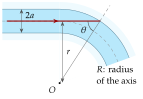
In the bend the ray keeps going straight until it meets the outer boundary, a circle of radius about . There the normal is the radius . The perpendicular distance from to the ray is , which fixes the angle. Total internal reflection needs .
In the triangle formed by , the hit point and the foot of the perpendicular from onto the ray, the hypotenuse is and the side opposite the angle at is . The angle at between the ray and the radius is the angle of incidence, so .
Axial ray, : gives
The ray along the inner edge of the core, , meets the outer wall most steeply: , that is , gives
Plastic fibre (, , ): for the axial ray and for all parallel rays. Glass multimode fibre (, ): and .
At the plastic fibre has () for the axial ray, above (): trapped. The inner-edge ray has (): it escapes.
As , : a straight fibre traps every ray parallel to the axis. A larger index step allows tighter bends, at the price of more modal dispersion (Problem 7.6.4).
Rays that already travel at the edge of the acceptance cone meet the wall at in the straight part, so any bend releases some of them: bend loss strikes the highest-order modes first. Datasheets of plastic fibre therefore quote a minimum bend radius of about to . For a single-mode fibre the ray picture fails. There the loss comes from the evanescent tail, which on the outside of the bend would have to travel faster than light and radiates instead. Standard single-mode fibre is specified at a radius, bend-insensitive types down to .
cf. Problem 7.6.4