Section 7.6 · Further exercises · 3 of 5
Exercise 7.6.3: A coating with a prescribed surface reactance
About the further exercises of Section 7.6
Five further exercises on dielectric waveguides, in the spirit of Problems 7.6.1–7.6.4 and the home exercises, graded from easy to harder: light launched into a fibre, a bent fibre, a coating designed for a surface wave, a measurement of permittivity with a surface wave, and a silicon photonic waveguide. They use only the relations listed at the head of this subsection and Snell's law and the Fresnel formulas of Section 6.4.
A coating with a prescribed surface reactance
#A surface-wave launcher at needs a metal plane whose surface impedance for TM waves, seen from the air, is with . The plane is coated with PTFE, .
- Find , and of the TM surface wave, and the heights above the coating at which its field has fallen to and by .
- Find the coating thickness .
- Does this coating guide TM alone at ?
- What is the largest that a PTFE coating can give at while guiding TM alone?
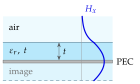
This is Problem 7.6.2 backwards. fixes , hence and . The TM condition (with for ) is then solved for directly, without iteration.
, .
so . The field falls to at and by at above the coating.
Inside the coating
in the coating (metal at ) and above it. Continuity of and of at gives
TE starts at
and TM at twice that. At only TM propagates.
TM alone needs , so . At that thickness, , the equation with gives , , so and
Forward, as in Problem 7.6.2: , , , and . Also .
The thicker the coating, the larger the reactance and the tighter the wave clings to the surface. A low-permittivity coating binds the wave loosely ( only above , a height of ) and cannot reach large reactances before TE appears. Larger needs a higher or a corrugated surface.
cf. Problem 7.6.2