Section 7.6 · Further exercises · 4 of 5
Exercise 7.6.4: Measuring a sheet's permittivity with its surface wave
About the further exercises of Section 7.6
Five further exercises on dielectric waveguides, in the spirit of Problems 7.6.1–7.6.4 and the home exercises, graded from easy to harder: light launched into a fibre, a bent fibre, a coating designed for a surface wave, a measurement of permittivity with a surface wave, and a silicon photonic waveguide. They use only the relations listed at the head of this subsection and Snell's law and the Fresnel formulas of Section 6.4.
Measuring a sheet's permittivity with its surface wave
#A free-standing sheet of an unknown low-loss plastic, thick, carries the TE surface wave at . A metal plate across its far end makes a standing wave, and a small probe moved along the sheet finds adjacent minima apart.
- Find , , and the decay constant in the air.
- Find of the plastic.
- Is the sheet single-mode at ?
- How much does a error in change the result?
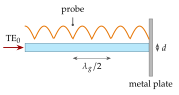
The measurement gives , and alone gives outside (air is known). Inside, is unknown, but the TE condition contains only . Once is known, .
Minima are apart: . With and ,
. Solve by bisection on : , . Then
: TE and TM start at . At only TE and TM propagate, and the measurement sees a single mode if the launcher excites TE. The decay length is .
Repeating (b) with smaller and larger, and , gives and : a error in costs about in .
and . The value fits PMMA, about at microwave frequencies.
The method needs no metal enclosure and no sample machining. Its sensitivity grows with the part of the power inside the sheet: for a thin sheet hardly differs from whatever is, so and should be chosen with close to, but below, .
cf. Problem 7.6.1