Section 7.2 · Topic 3 of 12
7.2.3 TM modes
For the TM case but :
and Eq. (7.1.11) with , gives
The boundary conditions are now on itself:
Only needs a condition: is proportional to , so the other tangential component vanishes by itself. is normal to the plates and may be nonzero there, where it ends on a surface charge.
Exactly as for TE, , and with
It is the same equation as in the TE case. Only the boundary condition differs: now the function itself, not its slope, must vanish on the plates. At ,
and at , , so again with and
With in Eq. (7.2.16),
The th term is the TM mode.
with and .
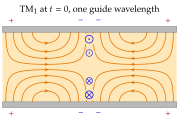
The magnetic field of a TM mode points along the plates (), and it is strongest on the plates. The electric field lies in the plane: its lines start on positive surface charge on a plate, arch along , and end on negative charge on the same plate (Figure 7.2.3).
Cutoff of the TM modes
The phase constant is again , and in order to have a propagating TM mode must be real: , Eq. (7.2.14). The cutoff frequency is the same as that of the TE waves, and the lowest TM mode with is TM.
TE and TM have the same , hence the same , , , and . Two modes with the same cutoff are called degenerate. They differ in the field pattern and in the wave impedance, .
Show from Eq. (7.2.23) that the TM field satisfies both boundary conditions on the plates.
The tangential components are , which is zero at and , and . The normal is zero everywhere. on the plates is normal to them and ends on a surface charge .