What happens to the TM series as n→0? Ez∝sin(0)=0 vanishes, but the transverse fields need not. To see this, rewrite Eqs. (7.2.21)–(7.2.22) with a new amplitude
An=hnjωεC2n,(7.2.24)
so that jωεC2nnπ/(bhn2)=(nπ/bhn)An and jτnC2nnπ/(bhn2)=(nπ/bhn)(τn/ωε)An:
Ez∝C2n vanishes as n→0, but Hx written with An has the finite factor nπ/(bhn)=1, and the amplitude An survives the limit. The TM0 mode (n=0, h0=0) is the TEM mode:
The TEM mode does not have any cutoff frequency. It propagates at every frequency.
In plain words
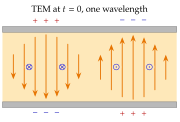
The TEM mode is a plane wave between the plates. Its fields are uniform across the gap, and E×H points along +az since (−ay)×ax=az. It is the uniform plane wave of Section 6.1: the plates sit exactly where its E is normal and its H is tangential, so they disturb nothing.
Figure 7.2.4.The TEM mode, side view, real fields at t=0: Ey=−ηA0cos(ωt−kz) and Hx=A0cos(ωt−kz) with A0 real. The electric field runs straight from plate to plate, uniform across the gap. Where E points along −y, H points along +x (⊗), and (−ay)×ax=az. The two plates carry equal and opposite surface charges.
⚠Common mistake · Losing τn or counting it twice
Rewriting Eq. (7.2.21) with An and writing the factor of Ey as (nπτn/bhn)τn/ωε. Substituting C2n=hnAn/(jωε) into −jnπτnC2n/(bhn2) gives (nπ/bhn)(τn/ωε)An with a single τn, as Eq. (7.2.25) shows. The check is the wave impedance: −Ey/Hx must equal τn/ωε=ZTM, which has the dimension of ohms only with one τn.