Section 7.3 · Topic 7 of 11
7.3.7 Standard WR guides and the single-mode band
Single-mode operation requires the frequency to lie above the cutoff of TE and below the cutoff of the next mode,
Commercial guides come in a standard series (Table 7.3.1). The WR number is the width in hundredths of an inch: WR-90 has . Each guide has a recommended band of roughly to , far enough above cutoff for low loss and low dispersion and safely below the next mode, and the height is , which gives the widest single-mode band together with the largest (power) and (low loss).
Table 7.3.1. Standard rectangular waveguides (air filling, cutoffs with ).
| guide | [mm] | band [GHz] | / [GHz] |
|---|---|---|---|
| WR-340 | – | / | |
| WR-284 | – | / | |
| WR-187 | – | / | |
| WR-137 | – | / | |
| WR-90 | – | / | |
| WR-62 | – | / | |
| WR-42 | – | / |
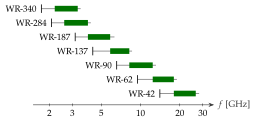
Which standard guide would you choose for a link, and why not the next larger one?
WR-90: lies in its band, at . WR-137 () would carry TE too at , and possibly TE (): it is no longer single-mode.