Section 7.6 · Topic 3 of 14
7.6.3 TE modes of the slab
The even TE mode
Take inside and match it, at each face, to the decaying exponential outside:
The tangential component is continuous at by construction. The magnetic field follows from the first set Eq. (7.6.5):
is tangential to the faces, and since both media are nonmagnetic and carry no surface current, it must be continuous as well (the boundary conditions of Sections 3.4.6 and 4.2.3, which hold for time-varying fields too). Continuity of means continuity of . At , from inside and from outside,
The odd TE mode
With inside and outside (upper sign for ), the same steps give .
to be solved together with , Eq. (7.6.8).
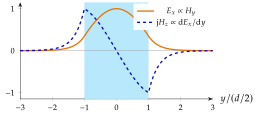
The field and its slope must both join smoothly at the faces. A cosine inside can join a decaying exponential only at special values of , where the cosine is already falling at exactly the rate of the exponential. Those values are the modes.
Figure 7.6.3 shows the result for the lowest mode: and the slope that defines are continuous, and changes sign at the centre, where is largest.
Wave impedance and power
By Eq. (7.6.10) the ratio
is the same inside and outside the slab: has the profile of . The time-average power density along is , and the power carried per metre of width in is
Across the guide, because is out of phase with : no power leaves the slab, as anticipated in Section 7.6.1.
is perpendicular to the plane of incidence of the zig-zagging waves, the -plane. A TE mode is therefore built of the perpendicularly (S) polarised plane waves of Section 6.4, and its reflection at the faces is governed by . Section 7.6.8 uses exactly this.