Section 5.1 · Topic 4 of 6
5.1.4 Local, universal, field equations
Two properties of Eq. (5.1.1) deserve a moment's attention before we look at the new terms in detail. Maxwell's equations are local: they connect the values of the field components, and of their first derivatives, at one point of space and at one instant of time. Nothing in them refers to a distant charge, as Coulomb's law does. The field at a point is determined by what happens in its immediate neighbourhood, and an influence must travel from point to point to reach a distance, which is why the equations predict waves. They are also universal: they hold in every medium, in metals, insulators, plasmas and in vacuum, the medium entering only through , and . Equations of this kind are called field equations in physics.
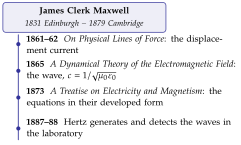
Which of the four equations did not change when the fields became time dependent, and which of the two new terms came from an experiment?
The two divergence equations ③ and ④ are unchanged. Of the two new terms, came from Faraday's experiments of 1831, while came from Maxwell's demand that the equations be consistent with the conservation of charge.