Section 2.4 · Topic 1 of 5
2.4.1 The fundamental theorem for gradients
The ordinary fundamental theorem of calculus says that integrating a derivative undoes the differentiation. The integral of the rate of change over an interval depends only on the values of the function at the two ends of the interval. The gradient theorem is the same statement in three dimensions.
For a scalar function with continuous first derivatives and any path from the point to the point ,
Why it is true
Walk along in many small steps . By Eq. (2.3.47), the quantity is exactly the change of during one step. Adding the changes of all the steps gives the total change of between the start and the end of the walk, which is , whatever route was taken.
Describe the path by a parameter , for , with and . Along the path , and by Eq. (2.3.47) (the chain rule) is exactly the change of along this step:
The last step is the ordinary fundamental theorem of calculus for the function .
Meaning and consequences
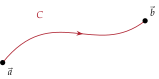
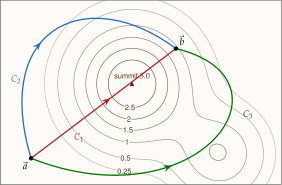
- Path independence. The integral (2.4.1) is the same for every path joining to (Figure 2.4.1). Think of as the height of a landscape: however you walk from to , the total climb (counting descents as negative climbs) is the difference in altitude (Figure 2.4.2).
- Zero circulation. If the path is closed (), . A field that is the gradient of a scalar has no circulation around any loop: a round trip always brings you back to the altitude where you started.
- Electrostatics. We shall see in Section 3.3 that the electrostatic field is the (negative) gradient of a scalar potential, . The theorem then states that the work done by the field on a charge moved between two points does not depend on the path, and that .
For a gradient field, the line integral is a "height difference": only the start and the end matter. If you know , you never need to integrate along a path. Just subtract.
Let . What is along a complicated spiral from the origin to the point ? And around a closed loop?
, whatever the shape of the spiral. Around any closed loop the result is .