Section 2.4 · Topic 3 of 5
2.4.3 Stokes' theorem
The curl was defined in Eq. (2.3.55) as the circulation per unit area around an infinitesimal loop. Stokes' theorem is the corresponding statement for a surface of finite size.
Let be an open surface bounded by the closed curve , and let have continuous first derivatives on . Then
where the direction of and the sense of traversal of are related by the right-hand rule: when the fingers of the right hand curl in the direction of travel along , the thumb points along .
In words: the circulation of a vector field around a closed curve equals the flux of its curl through any surface bounded by that curve.
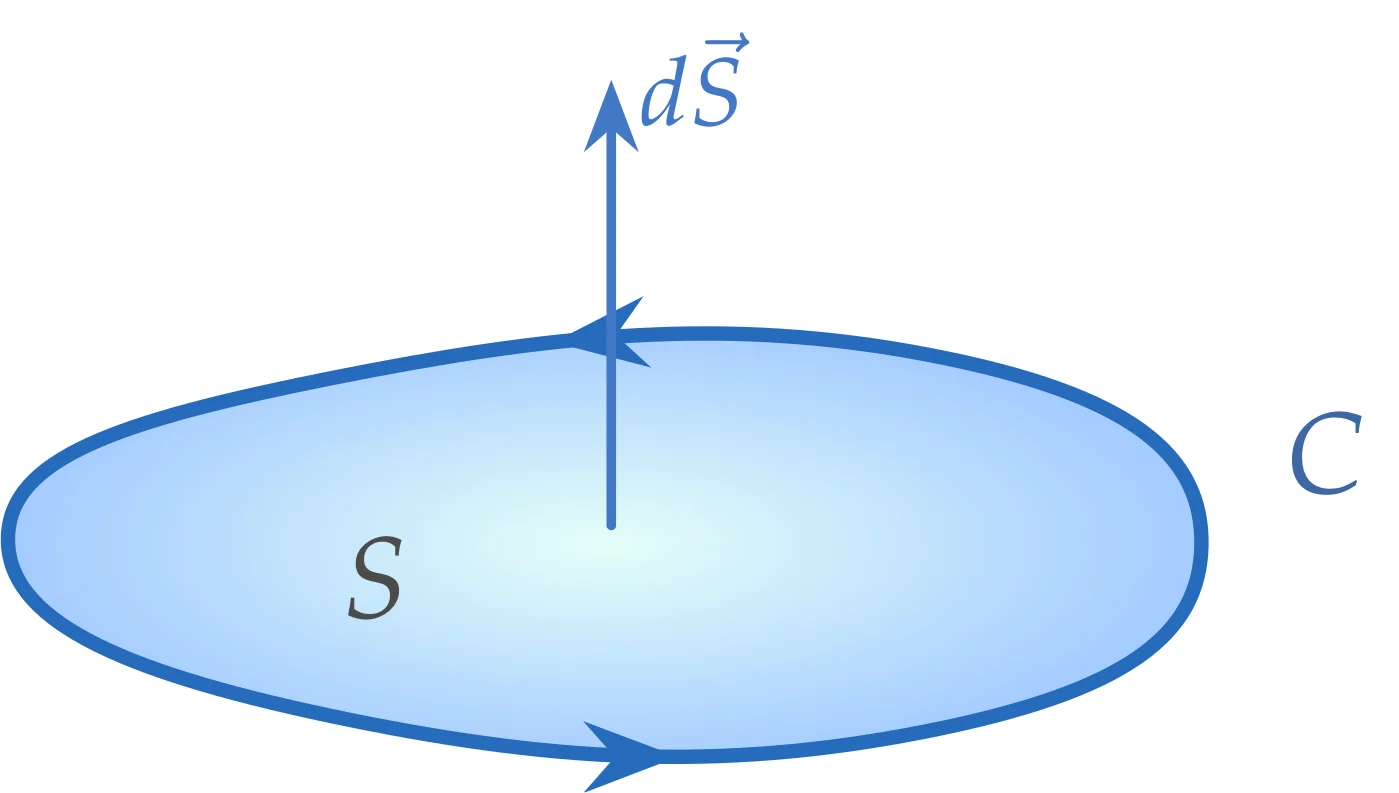


Why it is true
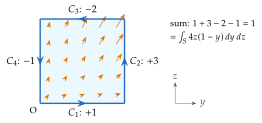
Divide into many small patches and traverse the boundary of each in the same (right-handed) sense (Figure 2.4.8). By the definition (2.3.55) the circulation around patch is , to first order. When all the circulations are added, every interior edge is traversed twice, in opposite directions, by the two patches that share it, and these contributions cancel. Only the outer edges, which together form , survive:


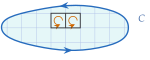
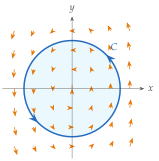
Try it yourself: move and resize the loop in the vortex field below. The circulation around the loop always equals the flux of the curl through the enclosed area, also for a loop that does not surround the centre.
Meaning and consequences
-
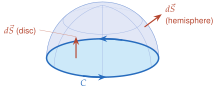
The left-hand side of Eq. (2.4.3) depends only on the curve . Hence the flux of a curl is the same for every surface spanning the same rim, as noted in Figure 2.4.7: a flat disc, a hemisphere or a "butterfly net" bounded by all give the same answer. We shall use this freedom in Example 2.4.5.
-
If everywhere in a region (and the region has no holes through which a loop could be threaded), the circulation around every closed curve in it vanishes. Conversely, a field with non-zero circulation must have a curl somewhere on every surface spanning the loop.
-
Combining the theorems gives two identities. For the gradient theorem gives for every loop, so for every surface, which is possible only if
Likewise, a closed surface has no rim, so Stokes' theorem gives . By the divergence theorem, for every volume, so
Both identities can of course be checked directly from the Cartesian formulas of Section 2.2. The first one is the reason why the electrostatic field is curl-free.
Choosing the direction of travel along and the direction of independently. They are tied together by the right-hand rule, and choosing them inconsistently flips the sign of one side of the theorem.
The field has zero curl for (Figure 2.3.32). Compute its circulation around the circle in the -plane (counter-clockwise). Does the result contradict Stokes' theorem?
. No contradiction: every surface spanning this circle is pierced by the axis, where the field is singular, so the hypothesis of the theorem fails, just as for and the divergence theorem. (This field has the shape of the magnetic field of a long straight wire, which you will meet later in the course.)