Section 2.4 · Examples · 2 of 5
Example 2.4.2: Divergence theorem for a unit cube
Divergence theorem for a unit cube
#Verify the divergence theorem for the vector field
and the unit cube , , shown in the figure. The faces are numbered (i) , (ii) , (iii) , (iv) , (v) , (vi) .
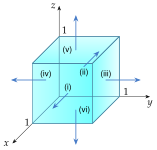
Both sides are easy in Cartesian coordinates: the divergence is a polynomial, and on each face of the cube is a Cartesian unit vector, so only one component of crosses each face.
The divergence is
Over the cube, using and (and the same for and ),
On each face points outwards along one Cartesian unit vector, so only one component of contributes. The mixed terms , , average to over a face:
- (i) , : ,
- (ii) , : ,
- (iii) , : ,
- (iv) , : ,
- (v) , : , and
- (vi) , : .
Adding the six faces, (Figure 2.4.5).
Notice how the two sides correspond term by term. The , and parts of the divergence produce the net fluxes , and of the three pairs of opposite faces. The mixed terms , , do not change along their own direction: each of them carries the same flux into the cube through one face and out through the opposite face, so it contributes to every single face but not to the total, just as it contributes nothing to the divergence. Six surface integrals were replaced by one volume integral.
Check. Both numbers are equal. The three faces through the origin have negative flux (the field enters there), the three faces through the corner have positive flux, and the outflow wins because the divergence is positive everywhere inside the cube.