Section 2.4 · Examples · 5 of 5
Example 2.4.5: Stokes' theorem for a circle
Stokes' theorem for a circle
#Verify Stokes' theorem for the vector field
and the circle of radius in the -plane centred at the origin, traversed counter-clockwise when viewed from the positive axis, as shown.
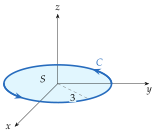
Parametrise the circle by the azimuth for the line integral. The curl turns out to be uniform, so its flux through the flat disc is just "curl area". As a bonus we check that a different surface with the same rim gives the same flux.
Parametrise the circle by the azimuth : , , (increasing is counter-clockwise seen from ). Then , , and
Since ,
(Alternatively, in cylindrical coordinates with , and by the transformation of Section 2.3, and the same integral results.)
The counter-clockwise sense corresponds, by the right-hand rule, to on the flat disc of radius . The curl is
a uniform field. Its flux through the disc is simply times the area :
To illustrate the first consequence of Stokes' theorem, take instead the upper hemisphere , , whose rim is the same circle (Figure 2.4.10(b)). With the outward normal (, which agrees with the right-hand rule for the counter-clockwise rim) and ,
the same value, as it must be.
Check. Figure 2.4.10(a) shows that the field circulates counter-clockwise, in the chosen direction of travel, so a positive circulation is expected.