Section 2.4 · Examples · 4 of 5
Example 2.4.4: Stokes' theorem for a square
Stokes' theorem for a square
#Verify Stokes' theorem for the vector field
and the unit square in the -plane (, , ), traversed along , , , as shown.
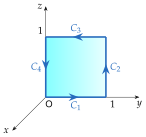
On each side of the square only one coordinate changes, so is or . For the surface side we only need the component of the curl normal to the square, , evaluated on .
The path runs O O, i.e. counter-clockwise when the -plane is viewed from the positive axis (along , then , and ). By the right-hand rule .
On the plane the field is .
- : , , : ,
- : , , : ,
- : , , : , and
- : , , : .
(On and the vector or automatically points in the direction of travel because or there, so the limits take care of the sign.) Hence .
Only the component of the curl is needed:
which on the surface equals . (For completeness, and , but they do not contribute because .)
The positive sign means that the net circulation is counter-clockwise as seen from the axis. Note also that the term of played no role: it vanishes on the plane , and so does its contribution to . Figure 2.4.9 shows where the positive sign comes from.