Section 2.2 · Topic 1 of 8
2.2.1 The nabla operator
Fields change from point to point, and the laws of electromagnetics are statements about how they change. The rates of change of a function of three coordinates are its partial derivatives, and it is convenient to package the three first-order partial derivatives into a single object, the nabla (or del) operator:
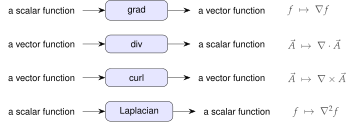
Nabla is a vector operator: it has the formal structure of a vector, with components that are first-order partial derivatives with respect to the space coordinates, but it is not a vector by itself: it does nothing until it acts on a function standing to its right. It can be applied to a scalar function or to a vector function, and, because it behaves like a vector, it can act in the three ways in which a vector can multiply something (Figure 2.2.1):
- "times a scalar" : , the gradient, a vector,
- "dot" a vector : , the divergence, a scalar, and
- "cross" a vector : , the curl, a vector.
Combining the first two gives a fourth, second-order operator, the Laplacian . Because contains derivatives, its position matters: is a scalar function, whereas is again an operator. Each derivative carries a factor , so applied to a quantity measured in volts gives a result in .
Which of these expressions make sense? (i) , (ii) , (iii) , (iv) .
Follow the types of Figure 2.2.1. (i) No: divergence needs a vector, is a scalar. (ii) Yes: is a vector, and so is its curl (we shall find that it is always ). (iii) Yes: is a scalar, and its gradient is a vector. (iv) No: is a scalar, which has no divergence.