Section 2.2 · Topic 4 of 8
2.2.4 Curl
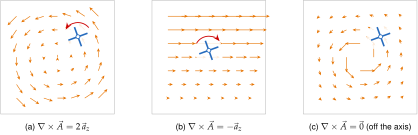
Now put a tiny paddle wheel into the flow, with its axle fixed in some direction, and watch it (Figure 2.2.7). If the water pushes harder on the blades on one side than on the other side, the wheel starts to turn. The curl of the field measures this tendency to rotate: its direction is the axle direction in which the wheel spins fastest (by the right-hand rule), and its size tells how fast. Surprisingly, a field whose arrows go round in circles need not have any curl, and a field with straight, parallel arrows can have one. Figure 2.2.7 shows both.
Circulation and the definition of curl
The circulation of around a closed path is the line integral : we walk once around and add up the components of along our direction of travel times the lengths of the steps (line integrals are treated in detail in Section 2.3.3). If is a force, the circulation is the work done around the loop. For the paddle wheel, the circulation around the rim measures the net push of the fluid along the rim, i.e. how strongly the wheel is driven round.
The curl of a vector field is a vector whose magnitude is the maximum net circulation of per unit area, as the area tends to zero, and whose direction is the normal direction of the area when the area is oriented so as to make the circulation maximum. Equivalently, its component along any unit vector is
where is a small plane area with normal bounded by the curve , and is traversed in the direction given by the right-hand rule: with the thumb along , the fingers curl in the direction of travel.
The two statements agree: by (2.1.7) the left-hand side of (2.2.7), , is largest when is parallel to , and its largest value is the magnitude of the curl.
From the definition to the formula: a small rectangle
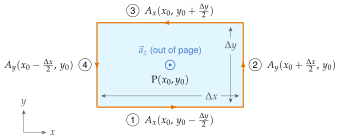
To obtain the -component of the curl, take and a small rectangle in a plane , centred at , with sides and (Figure 2.2.8). By the right-hand rule it is traversed counter-clockwise when seen from the side. On each side we take the tangential component of the field at the midpoint:
| side | direction of travel | contribution to |
|---|---|---|
| 1 (bottom, ) | ||
| 2 (right, ) | ||
| 3 (top, ) | ||
| 4 (left, ) |
Sides 2 and 4 together give, after a Taylor expansion about exactly as for the divergence,
and sides 1 and 3 give
Dividing the circulation by and letting the rectangle shrink,
which is the term of (2.2.8) below. Small rectangles in the planes and give the other two components (simply rotate the indices cyclically, ). The three components fit exactly into the determinant form of the cross product (2.1.8), with in the middle row (the derivatives act on the components in the bottom row):
The curl turns a vector field into another vector field.
Imagine a tiny paddle wheel placed in a flowing fluid with velocity field , with its axle along . It turns if the fluid pushes harder on the blades on one side than on the other, and its rate of rotation is proportional to . The direction of is the axle direction in which the wheel spins fastest (Figure 2.2.7 and Figure 2.2.10, right). A non-zero curl at a point is sometimes called a vortex source of the field there. Curl does not mean that the field lines go round in circles:
- The shear field has straight field lines, but , because the flow is faster above the wheel than below it.
- The field , whose lines are circles around the -axis with strength decreasing as , has everywhere except on the -axis, where it is not defined. Around a small loop made of two arcs (radii , same opening angle) and two radial segments, the outer arc is longer by the factor by which the field there is weaker, so the two arc contributions cancel and the radial segments contribute nothing.
- The rigid rotation has .
A field whose curl is zero everywhere is called irrotational.
Place the paddle wheel anywhere in the rigid rotation below (the tool lists it as "vortex", and it is the field of Figure 2.2.7a): it turns at the same rate everywhere, because the curl is at every point, not only at the centre.
The curl answers "would a tiny paddle wheel spin here, about which axis, and how fast?". It is the circulation around a tiny loop, per unit area. Only the change of each component across its own direction matters: versus , and so on.
In electrostatics the electric field is irrotational, , which is why it can be written as the gradient of a potential (Section 3.3).
Without writing the full determinant, find the curl of and of .
Only is non-zero, so only the terms (in the bracket) and (in the bracket) can survive. For both vanish: (it grows along its direction, not across it). For : , the shear flow of Figure 2.2.7b.
Now try the shear flow itself: the streamlines are straight and parallel, yet the paddle wheel turns clockwise everywhere, because .
Mixing up the order of the two terms in a bracket of (2.2.8), which flips the sign of that component. The pattern is cyclic: if is , or , the bracket is . Thus the first terms are , and . When in doubt, write out the determinant.