Section 2.2 · Topic 7 of 8
2.2.7 What the three operators actually mean
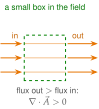
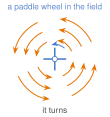
The formulas of gradient, divergence and curl are easy to apply, and just as easy to apply without remembering what they mean. The three pictures of Figure 2.2.10 are the meaning, and they are what we should have in mind for the rest of the course. Table 2.2.1 puts the four operators side by side.
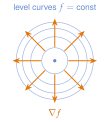
- Gradient: how a scalar field changes. is perpendicular to the level surfaces of , points the way grows fastest, and is longest where the level surfaces crowd together.
- Divergence: how a vector field spreads out. is the net flux out of a small box, per unit volume: positive at a source, negative at a sink, zero when as much enters as leaves.
- Curl: how a vector field circulates. is the circulation per unit area: not the field going round in circles, but one side of a small loop being pushed harder than the other.
Table 2.2.1. The four operators at a glance (Cartesian forms).
| acts on | gives | measures | zero everywhere means | |
|---|---|---|---|---|
| scalar | vector | steepest increase of | is constant | |
| vector | scalar | net outflow per unit volume | solenoidal (no sources) | |
| vector | vector | circulation per unit area | irrotational (no vortices) | |
| scalar | scalar | value minus neighbours' average | has no interior max./min. |
Every law in this course is a statement about a field: how it spreads out (), how it circulates (), and how a potential generates it (). Maxwell's four equations in differential form are two divergences and two curls (, , , ) and nothing else. A vector field is determined (up to boundary conditions) once its divergence and its curl are known everywhere, which is why these two operators are the language in which the field laws are written. In Section 2.3 we shall write all four operators in cylindrical and spherical coordinates, and in Section 2.4 the "per unit volume" and "per unit area" definitions of divergence and curl will grow into the integral theorems of Gauss and Stokes.