Section 2.2 · Topic 3 of 8
2.2.3 Divergence
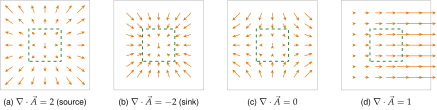
Think of a vector field as the velocity of a flowing fluid, and draw a small imaginary box somewhere in the flow (Figure 2.2.4). Count what flows out of the box and subtract what flows in. If the result is positive, fluid is being created inside the box: there is a spring, a source. If it is negative, there is a drain, a sink. If it is zero, everything that enters also leaves. The divergence is exactly this "net outflow", measured per unit volume of the box.
Flux through a small surface
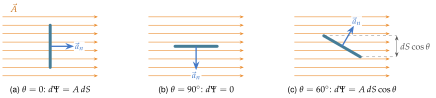
To turn "what flows through a surface" into mathematics we need the notion of flux. The flux of a vector field through a small surface element of area with unit normal is
where is the angle between and . Only the normal component of the field crosses the surface (Figure 2.2.5). For the velocity field of a fluid, is the volume of fluid flowing through per second. For a closed surface we always choose pointing outward, so that the total flux is the net amount "flowing out" of the enclosed volume: positive if more leaves than enters.
The divergence of a vector field at a point is the net outward flux of per unit volume, as the volume about the point tends to zero:
where is the closed surface bounding the small volume .
From the definition to the formula: a small box
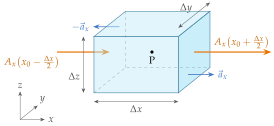
Let us evaluate (2.2.5) for a small rectangular box centred at , with edges , , parallel to the axes (Figure 2.2.6). The plan has three steps: (1) the flux through the two faces perpendicular to the -axis, (2) the same for the other two pairs of faces, and (3) divide by the volume and shrink the box.
Step 1. Consider first the two faces perpendicular to the -axis. On them only is normal to the surface, so only contributes.
-
On the face at the outward normal is . For a small face we may take the field at its centre:
-
On the opposite face, at , the outward normal is , so the flux carries a minus sign:
Expanding in a Taylor series about the centre,
the values at the centre cancel in the sum of the two face fluxes and the two half-differences add up:
Step 2. The pairs of faces perpendicular to and to give, in exactly the same way, and .
Step 3. Adding the three pairs, dividing by , and letting the box shrink to the point (the neglected higher-order terms vanish in the limit) we obtain
This is also what we get by formally "multiplying out" the dot product of (2.2.1) with , with each derivative acting on the component that stands next to it. The formula is therefore not a definition by itself but a consequence of the physical definition (2.2.5). The divergence turns a vector field into a scalar field.
A positive divergence at a point means that more flux leaves an infinitesimal neighbourhood of the point than enters it: the point is a source of the field. A negative divergence marks a sink, and a zero divergence means that as much enters as leaves. A field whose divergence is zero everywhere is called solenoidal. Note that a field can have non-zero divergence without "spreading out" visibly: has parallel field lines, yet because the field grows in the direction in which it points, so each box lets out more than it takes in (Figure 2.2.4d and the middle picture of Figure 2.2.10).
The divergence answers "is something being produced here?". Put a tiny box around the point and count the flux going out minus the flux coming in, per unit volume. Only the change of each component along its own direction matters: , , .
Move the probe box around the source field below: the net outflow divided by the size of the box is the same everywhere (the divergence is at every point), not only at the origin where the arrows seem to start. Then switch to the other fields and compare with Figure 2.2.4.
The divergence has the unit of the field divided by metres. In Section 3.2 we shall find that the sources of the electric flux density are the charges, : the divergence of the field is the volume charge density at that point.
Find the divergence of the uniform field and of . Which one is a source?
: a uniform flow enters and leaves each box equally. : although its lines are parallel too, this field is a source everywhere, because it grows along its own direction.
Giving the divergence as a vector, for example The dot product produces a scalar: the three derivatives are simply added. Another frequent slip is differentiating a component with respect to the wrong variable (e.g. ). In the divergence each component is differentiated only with respect to its own coordinate.