Section 5.3 · Topic 3 of 6
5.3.3 The minus sign is Lenz's law
The circulation and the flux in Eq. (5.3.7) must be taken with the same right-hand rule: if the thumb points along , the fingers give the sense of . With that convention the minus sign is forced by the equations, and it has a physical reading, stated by H. Lenz in 1834: the induced current flows in the sense that opposes the change of flux that produced it. Figure 5.3.1 shows the two standard cases.
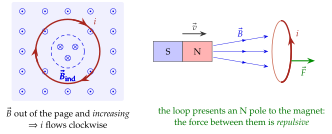
Watch the ring turn its N face toward the approaching magnet and its S face as the magnet leaves: the force always opposes the motion.
Suppose the induced current flowed the other way. The ring in Figure 5.3.1 would then attract the magnet, the magnet would speed up, the flux would change faster, the current would grow, the attraction would grow, and both the current and the kinetic energy of the magnet would increase without any source of energy. The minus sign forbids this: to keep the magnet moving you must push it, and the work you do is the heat produced by the induced current in the ring.
Choosing in one direction and going round in the sense that does not match it. The magnitude of comes out right, but the sign is wrong, and with it the sense of the induced current and the direction of the force. Fix first, let the fingers of the right hand give the sense of , and only then read off the sign of . When in doubt, check the sense of the current with Lenz's law.