Section 5.3 · Home exercises · 2 of 2
Home exercise 5.3.2: Sliding bar on rails
Sliding bar on rails
#A conducting bar of length slides at constant speed on two parallel rails closed by a resistor , in a uniform magnetic flux density perpendicular to the plane of the rails. The bar and the rails have negligible resistance.
- Find the emf and the current in the circuit.
- Find the magnetic force on the bar and its direction.
- Find the mechanical power needed to keep the bar moving and compare it with the electrical power dissipated in .
Adapted from: D. K. Cheng, Field and Wave Electromagnetics, 2nd ed., Example 7-2.
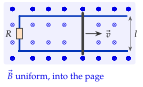
The generator of Section 5.3.4. Only the bar moves, so the motional emf is . The current then feels the force , and the power balance closes the argument.
Take the plane of the rails as the -plane with the bar moving along (to the right in the figure), down the page and (into the page), as in Figure 5.3.2.
Only the bar moves, so only it contributes to the motional emf:
taken along the bar in the direction (up the page). Check with the flux rule: the loop area is , and . The current is
It flows up the bar (the sense of ) and round the loop through . Lenz: the loop area, and hence the flux into the page, is growing, so the current circulates counter-clockwise to produce flux out of the page.
The force on the current-carrying bar is with (the direction of the current):
It is directed against : the field brakes the bar.
To keep constant an external force must be applied, delivering the mechanical power
The magnetic field stores nothing here. It only converts mechanical work into heat in .
The defaults are the numbers of the Check: read off 1.2 V, 2.4 A, 0.36 N and 2.88 W.
Numbers: , , , give , , and on both sides. Three laws meet in one picture: makes the emf, turns it into a current, and turns the current back into a force (all three from Chapter 4). Drive the bar and it is a generator. Feed from a source instead and the same bar is a linear motor (Exercise 5.3.4). Released without an applied force, the bar coasts to rest exponentially with .