Section 5.3 · Topic 4 of 6
5.3.4 The two ways to change the flux
Equation (5.3.7) splits the emf into two parts with different origins, and each can occur without the other.
Motional emf
The circuit moves and is static. Figure 5.3.2 shows the basic example: a conducting bar of length slides with velocity along two rails closed by a resistor , in a uniform field into the page. Only the bar moves, so only the bar contributes to the motional integral. On the bar
a force per unit charge directed along the bar (up the page), and integrating along the bar's length ,
Check with the flux rule: the loop encloses the area with , so and , the same answer. Since the flux into the page is growing, Lenz's law says the current circulates so as to make flux out of the page, that is counter-clockwise, up the bar and back through . Home exercise 5.3.2 completes the picture: the field pushes back on the current in the bar with the force , directed against , and the mechanical power needed to keep the bar moving is exactly the electrical power dissipated in the resistor. Drive the bar and the device is a generator, feed the rails from a source and the same bar is a linear motor (Exercise 5.3.4).
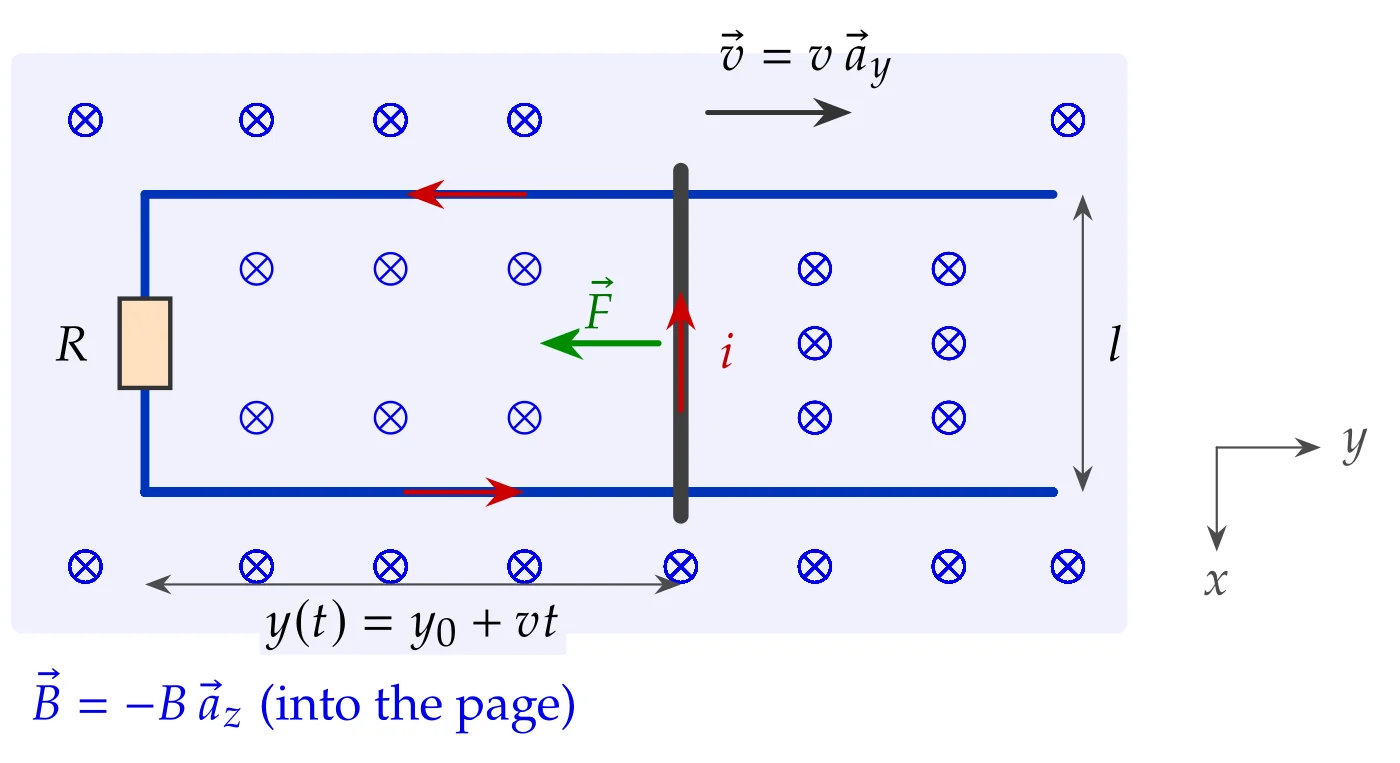
Change , , and , and reverse : the braking force always opposes the motion and .
Transformer emf
The circuit is fixed and varies in time. Then , and for a coil of close-wound turns . This is the emf of the transformer secondary, of the induction coil and of every pick-up loop, worked out for a circular loop in a sinusoidal field in Home exercise 5.3.1 and for a loop beside a wire in Exercise 5.3.2. Problem 5.3.1 treats a frame in which both parts are present at once and shows that their sum is exactly .
Pause while grows and while it shrinks, and check the sense of the induced current.
An observer riding on the bar of Figure 5.3.2 sees no motion of his circuit and no changing , yet he measures the same emf. In his own frame there is an electric field that drives the charges along the bar. The split into "motional" and "transformer" emf therefore depends on the observer, whereas the total does not. The rotating coil of Exercise 5.3.3 is the same situation: a transformer emf in the frame of the coil, a motional emf in the laboratory.
- Orient. Choose for the surface spanning the circuit and let the right hand fix the sense of and the reference sense of and .
- Flux. Compute with the limits of the integral following the circuit if it moves. Only the component of along counts.
- Differentiate. . If the circuit changes shape or is not obviously a flux (the Faraday disc of Problem 5.3.2), use instead.
- Check the sign with Lenz's law, then for a closed resistive loop.
Writing and trying to assign a potential to the induced . The induced field has , so : the work done around a closed loop is not zero, which is exactly what an emf is, and no single-valued potential exists. A voltmeter connected across two points of such a loop reads a value that depends on how its leads are routed (Exercise 5.3.1).
A fixed loop of area is placed with its normal along a uniform field that grows at . What is the emf, and in which sense does the induced current flow?
(transformer emf). The current flows so that its own field inside the loop is opposite to the growing : counter-clockwise when seen looking along , that is clockwise when points towards the viewer, as in Figure 5.3.1.
A rod moves at perpendicular to itself and to a field. What emf appears between its ends?
(motional emf). Nothing need be closed for the emf to exist: the charges in the rod are pushed to one end until their field balances .