Section 5.3 · Further exercises · 1 of 4
Exercise 5.3.1: Induced electric field of a solenoid
Four further exercises on Faraday's law, in the spirit of Problems 5.3.1–5.3.2 and the home exercises, graded from easy to harder. They use only the equations listed at the head of this subsection.
Induced electric field of a solenoid
#A long solenoid of radius carries a current that rises linearly, so that the uniform field inside grows at . Outside the solenoid . (a) Use Faraday's law on a circle of radius centred on the axis to find the induced inside and outside the solenoid. (b) Evaluate at and at . (c) What is the emf in a circular wire loop of radius around the solenoid?
Adapted from: B. M. Notaroš, Electromagnetics, Example 6.5.
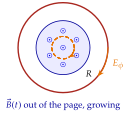
The electric counterpart of Exercise 5.2.1: Faraday's law in integral form on a circle, with the flux inside and outside. By symmetry is azimuthal and constant on each circle.
By symmetry . On a circle of radius , with (out of the page) and counter-clockwise,
The minus sign: the induced field circulates clockwise (seen from ) while grows, as Lenz's law requires.
and . The field is largest at the rim () and decays as outside.
, that is , the same as .
Units: is . There is an electric field in a region where is zero: Faraday's law is about the flux enclosed, not the field at the wire. The induced is not conservative (), so no potential can be assigned to it. This is the field that drives the current in every transformer secondary and in every induction-motor rotor.
cf. Faraday's law