Section 5.3 · Further exercises · 3 of 4
Exercise 5.3.3: The rotating coil generator
About the further exercises of Section 5.3
Four further exercises on Faraday's law, in the spirit of Problems 5.3.1–5.3.2 and the home exercises, graded from easy to harder. They use only the equations listed at the head of this subsection.
The rotating coil generator
#A coil of turns, each of area , rotates at about an axis in its plane, in a uniform field perpendicular to the axis. (a) Find the flux linkage and the emf . (b) Evaluate the peak and rms emf and the frequency. (c) How do and change if the speed is halved?
Adapted from: B. M. Notaroš, Electromagnetics, Example 6.12.
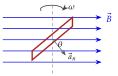
The flux through a flat coil in a uniform field is with the angle between the normal and , and rotation makes . With turns, .
The normal of the coil makes the angle with (), so the flux through one turn is and the flux linkage is . Then
It is a transformer-type emf in the rotating frame and a motional one ( on the two sides parallel to the axis) in the laboratory frame. Both give the same .
, , and .
Both and are proportional to : at , at . The ratio is fixed by the machine, the "volts per hertz" of a generator or of a motor run from an inverter.
Change the speed of the coil: the peak emf and the frequency grow together.
Units: . This is the alternator. With the ends of the coil connected to slip rings one obtains the sinusoid. With a split-ring commutator the sign is reversed every half turn and the output is , the DC generator.
cf. Faraday's law, transformer emf