Section 5.3 · Problems · 2 of 2
Problem 5.3.2: The Faraday disk generator
The Faraday disk generator
#The Faraday disk generator consists of a circular metal disk rotating with a constant angular velocity in a uniform and constant magnetic field of that is parallel to the axis of rotation. Brush contacts are provided at the axis and on the rim of the disk, as shown in the figure. Determine the open-circuit voltage of the generator if the radius of the disk is .
Source: D. K. Cheng, Field and Wave Electromagnetics, 2nd ed., Example 7-3.
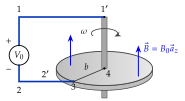
is constant, so the transformer term of Eq. (5.3.10) vanishes and . The only moving part of the circuit is the radial path inside the disk. The external wires and the brushes are at rest and contribute nothing.
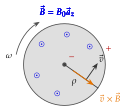
A point of the disk at radius moves on a circle with the speed , so and (Figure 5.3.4a)
a force per unit charge directed radially outward, growing linearly with .
Go round the circuit in the sense . On the segment , from the rim to the centre, with running from to :
With terminal connected to the axis, as drawn, the meter reads negative: pushes positive carriers outward, so the rim is the positive terminal. Reverse or and the sign reverses.
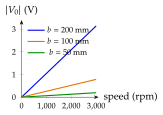
Vary , and the speed and check V at the book's values.
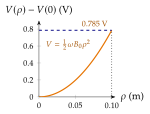
For , and , and
while the field inside the disk reaches at the rim (Figure 5.3.4b). Units: is . Nothing about the circuit changes in time, its shape is fixed and is constant, so there is no obvious : this homopolar machine is the clearest case in which one must return to the motional integral instead of the flux rule. Because while the rim speed is limited mechanically to a few hundred m/s (for with and one would need , a rim speed of ), such machines are built the other way round: very low voltage and very large current, with the brushes as the hard part.