Section 5.3 · Problems · 1 of 2
Problem 5.3.1: Moving frame in a time-varying field
Moving frame in a time-varying field
#A wire frame shown in the figure is on the plane at . Then it starts to move with a velocity of . The magnetic flux density is measured as
Find the electromotive force induced on the frame.
Adapted from: B. M. Notaroš, Electromagnetics, Problem 6.29.
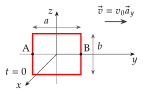
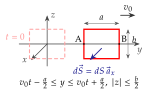
The frame stays in the plane , so its surface element is and only the component of produces flux. Compute with the moving limits , then . As a check, compute the motional and the transformer terms of Eq. (5.3.10) separately: they must add up to the same answer.
At time the frame occupies , in the plane (Figure 5.3.3a). The term is parallel to the frame and contributes nothing to the flux. With ,
Using with and ,
Differentiating the product ,
that is
The two terms in the bracket are exactly the two terms of Eq. (5.3.10). Transformer part: , so
Motional part: has only a component, so only the two sides parallel to , at , contribute. Going round the frame in the sense fixed by (counter-clockwise seen from , that is on the side and on ),
The two parts add up exactly to the bracket above. Units: is , and multiplied by the rate (in ) or by (in , with taken per metre) it gives .
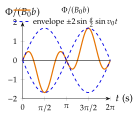
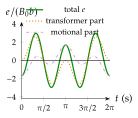
Figures 5.3.3b and c show and for , , . The flux vanishes whenever (the frame sits symmetrically about a zero of ) or whenever . At those instants is not zero: the emf follows the slope of , not its value. Neither of the two contributions alone gives the envelope of the total.
Scrub through time and compare the transformer and motional parts with their sum.